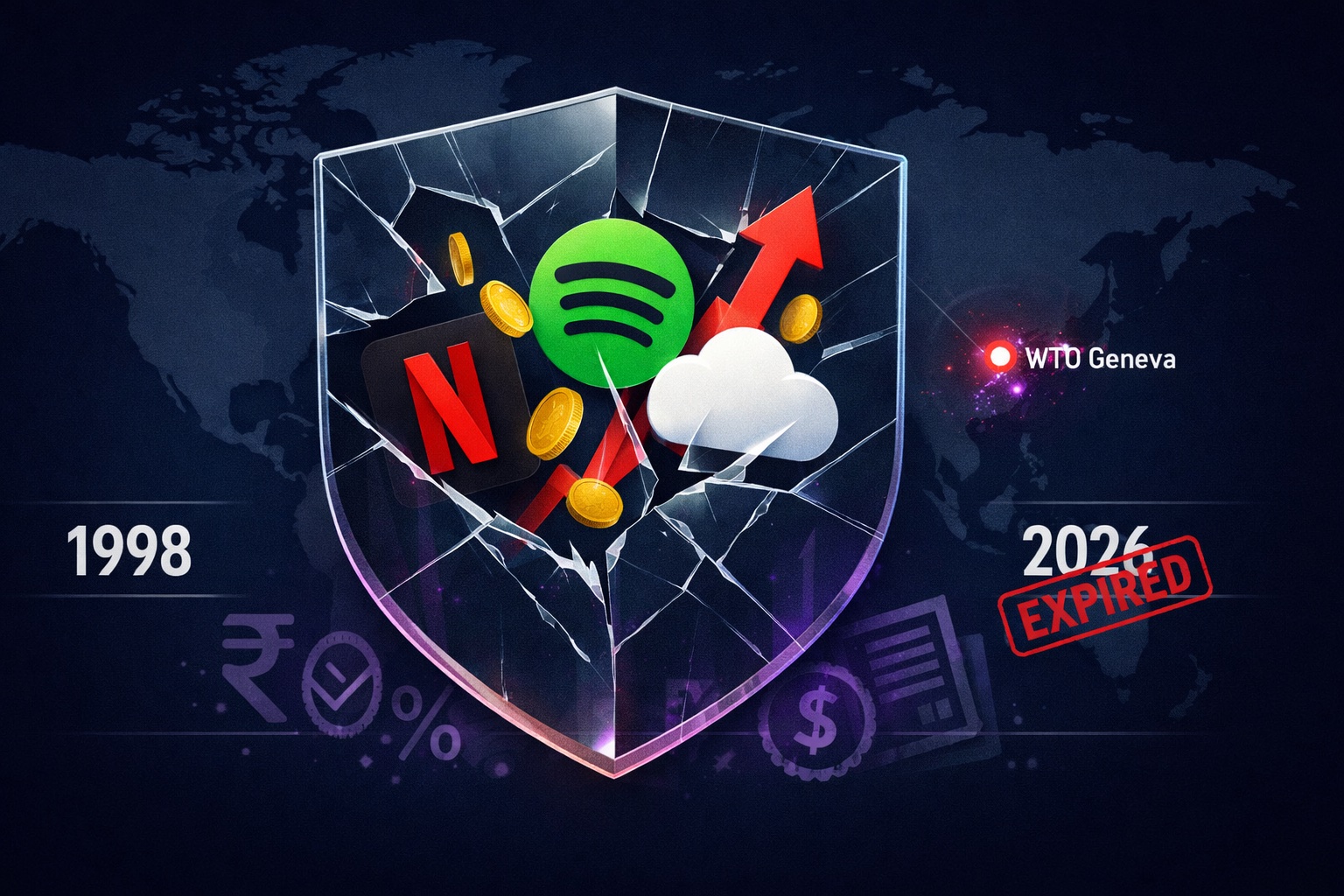
2024 — Digital trade crosses $7 trillion. Netflix has 283 million subscribers. Spotify has 640 million users. Cloud storage is a $100 billion industry. The moratorium is still in place — renewed every 2-3 years, quietly, without debate.
March 29, 2026 — Four days of talks in Yaoundé, Cameroon. The US wants the moratorium made permanent. India says no. Brazil links it to agriculture. The clock runs out.
For the first time in 28 years, countries are legally free to tax your Netflix stream, your Spotify playlist, your iCloud backup.
Will they?
Here's the short version of what just happened. The World Trade Organization has had a rule since 1998: no country can impose customs duties on "electronic transmissions." That means streaming video, music downloads, software, e-books, cloud services, data transfers — all of it crosses borders duty-free. Every two or three years, WTO members would renew this rule at their ministerial conferences. It was routine. Nobody fought about it.
Until they did.
The 14th WTO Ministerial Conference (MC14) in Yaoundé, Cameroon ended on March 29 without extending the moratorium. For the first time since the internet became a commercial force, there is no global agreement preventing countries from taxing digital goods at the border. The conference chair, Cameroon's Trade Minister Luc Magloire Mbarga Atangana, said simply: "We ran out of time."
India was at the center of the deadlock. And the reasons are more complicated — and more contradictory — than either side wants to admit.
What the Moratorium Actually Covered — and What Could Get CostlierBefore we get into the geopolitics, let's talk about what this means for you. The moratorium covered something called "electronic transmissions" — a deliberately vague term that has been stretched and debated for 28 years. In practice, it covers most things you do online that involve data crossing an international border.
| Service | What Crosses the Border | Could Face Duty? |
|---|---|---|
| Netflix / Prime Video | Video streams from US/EU servers to your device | Yes — streaming data is an electronic transmission |
| Spotify / Apple Music | Audio streams + downloads from foreign servers | Yes — same category as video |
| iCloud / Google Drive | Files stored on servers in the US, Singapore, etc. | Yes — data storage crosses borders |
| Adobe / Microsoft 365 | Software delivered via cloud, not physical disc | Yes — cloud-delivered software qualifies |
| Steam / PlayStation | Game downloads from international servers | Yes — digital game delivery |
| Kindle / e-books | Book files downloaded from Amazon's US servers | Yes — digital versions of physical goods |
| SaaS tools (Slack, Zoom) | Software-as-a-service from US companies | Possibly — depends on how duties are defined |
| WhatsApp / Instagram | Free services — data transmission, not "goods" | Unlikely — no direct payment for content |
The key question for Indian consumers is straightforward: if India imposes, say, a 10% customs duty on streaming content, would Netflix add that to your subscription? Almost certainly yes. Digital services operate on thin margins in India — Netflix's cheapest plan is already a globally adjusted price. Any new tax gets passed through to the consumer.
India Exports $200 Billion in Tech. It Just Voted to Tax Tech Imports.Here is the part of this story that nobody in the Indian trade establishment wants to talk about openly.
India's IT and digital services sector contributes 13% of GDP. It employs over 5 million people directly. India's IT exports crossed $200 billion in FY2025. Companies like TCS, Infosys, Wipro, and HCL earn the vast majority of their revenue by delivering digital services — software, cloud applications, data processing — across borders to clients in the US, Europe, and the Middle East.
These services are, by definition, electronic transmissions.
India just led a global effort to give every country the right to tax electronic transmissions at the border. If other countries follow India's logic and start taxing digital services coming in, Indian IT exports could face customs duties in their largest markets.
The Council on Foreign Relations calls this "the great disconnect" in India's digital trade policy. India is simultaneously one of the world's largest digital exporters and the loudest voice against digital trade liberalization. The argument that developing countries could earn 40 times more tariff revenue from e-commerce duties than developed ones cuts both ways — if everyone imposes duties, India's $200 billion tech sector is exposed.
India's Argument
- Moratorium costs developing countries $10 billion/year in lost tariff revenue
- US tech giants (Google, Netflix, Amazon) dominate — the moratorium protects their market access
- Countries should have policy space to tax digital goods like they tax physical goods
- India loses $500M–$2B/year under the moratorium
The Counter-Argument
- India exports $200B+ in IT services — digital duties could hit Indian companies in reverse
- Taxing data flows could fragment the internet into national silos
- India already taxes digital companies via GST (18%) and the equalization levy
- Customs duties on streaming raise consumer prices with minimal revenue gain
India's central argument is about money. But how much money, exactly? The answer depends on whom you ask — and what you count.
| Estimate | Source | India's Annual Revenue Loss | Notes |
|---|---|---|---|
| Conservative | WTO Secretariat | $225 million | Uses narrow definition of "electronic transmissions" |
| Moderate | UNCTAD (2017) | $500 million | Based on average MFN applied rates |
| High | Indian Commerce Ministry | $1.5–2 billion | Based on $117B digital import base at current rates |
| Global (developing) | UNCTAD | $10 billion (all) | Revenue loss across all developing WTO members |
Here's the uncomfortable comparison. India's potential customs revenue from taxing digital imports: $500 million to $2 billion per year. India's IT services exports that could face retaliatory duties if other countries follow suit: $200 billion per year. Even a 1% average duty on Indian IT exports would cost the industry $2 billion — matching or exceeding the revenue India hopes to gain.
India already taxes digital companies. The 18% GST on digital services applies to Netflix, Spotify, and cloud providers since 2017. The now-withdrawn equalization levy (6% on digital advertising, 2% on e-commerce supply) was specifically designed to capture revenue from foreign digital firms. India isn't losing all this revenue — it's collecting some of it through different instruments. The customs duty question is about whether India should have one more tool in the box.
What Is an "Electronic Transmission" Anyway? And Why Nobody Agrees.The entire 28-year-old moratorium rests on a term that the WTO has never formally defined: "electronic transmissions." This isn't an oversight. It's a deliberate ambiguity that served everyone's interests when digital trade was small. Now that it's a $7 trillion industry, the vagueness has become the battlefield.
Consider this: when you watch a movie on Netflix, are you importing a "good" (the movie file) or consuming a "service" (streaming entertainment)? If it's a good, customs duties apply — just like importing a physical DVD. If it's a service, they don't — customs duties only apply to goods, not services.
India's position: many electronic transmissions are really digital versions of physical goods. An e-book is a book. A downloaded game is a game. A streamed movie is a movie. If India can charge customs duty on a physical DVD shipped from abroad, why not a streamed version of the same film?
The US position: electronic transmissions are services, not goods. Streaming isn't importing — it's accessing. Cloud storage isn't a shipment — it's a subscription. You can't put a customs officer at a data cable.
This definitional fight is why the moratorium lasted 28 years without a permanent resolution. Nobody wanted to define the term because defining it would force a decision that half the membership would lose.
Three Countries. Three Demands. Zero Overlap.MC14 didn't fail because of a two-way fight between India and the US. It was a three-way deadlock that made compromise impossible.
| Country | Demand | Why |
|---|---|---|
| United States | Permanent extension of moratorium | Protects US tech giants' duty-free market access globally. USTR Jamieson Greer: "We are not interested in temporary extensions." |
| India | 2-year extension only (shift from earlier total opposition) | Wants to preserve policy space to tax digital imports. Revenue argument + industrial policy rationale. |
| Brazil | Linked e-commerce to agriculture deal | Refused to extend moratorium unless developed countries opened agricultural markets. Cross-issue linkage killed both tracks. |
India actually shifted its position during the talks. Commerce Minister Piyush Goyal initially signaled total opposition. By the final day, India offered a 2-year extension — the first time it had offered any extension at all. Diplomatic sources say a 4-year compromise was floated. But the US rejected anything less than permanent, Brazil blocked everything by linking to agriculture, and the clock expired.
The conference chair's statement — "we ran out of time" — is diplomatic code for: nobody wanted to move.
What Happens on April 1?The moratorium expired on March 29. So what happens next? Can India start taxing Netflix tomorrow?
No. Several barriers stand between the moratorium's expiry and actual customs duties on your screen.
Legal framework: India would need to classify digital transmissions as "goods" under the Customs Act. Currently, customs duties apply only to physical goods crossing India's borders. Streaming doesn't generate a bill of entry. There is no customs checkpoint for data. India's Budget 2026 did mention the possibility of customs on digital goods, but no specific rate or mechanism was announced.
Technical enforcement: How do you calculate the "value" of a Netflix stream for customs purposes? Is it the monthly subscription divided by hours watched? The licensing cost of each title? The bandwidth consumed? No country has built the infrastructure to assess customs duties on real-time data flows.
Trade retaliation risk: If India imposes duties unilaterally, the US could respond with trade measures against Indian IT services. Given that India just signed an 18% tariff deal with the Trump administration — and is negotiating a $500 billion trade package — unilateral digital duties would be diplomatically explosive.
Realistic timeline: If India decides to act, expect a budget announcement (February 2027 at the earliest), a CBIC notification, industry consultation, and implementation — minimum 12–18 months. This is a slow-burn change, not a sudden shock.
While India, the US, and Brazil were deadlocked at the main MC14 negotiations, something else was happening in a smaller room in Yaoundé.
66 WTO members — including the US, EU, Japan, Australia, UK, and China — adopted a plurilateral e-commerce agreement. This separate deal establishes the world's first baseline of global digital trade rules: provisions on electronic signatures, online consumer protection, paperless trading, and — crucially — a 5-year extension of the customs duty moratorium among signatories.
India was not among the 66.
This is significant for two reasons. First, it means the moratorium effectively continues for 40% of WTO members — the 66 countries that signed the plurilateral deal. The duty-free digital trade regime hasn't collapsed; it has split. Second, India also blocked the Investment Facilitation for Development (IFD) agreement at MC14, arguing that plurilateral deals erode the WTO's consensus-based decision-making.
India's position is principled — if the WTO starts operating through coalitions rather than consensus, smaller countries lose their veto power. But the practical result is that India is increasingly outside the room where digital trade rules are being written. The 66-member deal will shape norms, standards, and expectations. India will face those norms as a non-participant, not a co-author.
The Two-Track World
Digital trade now has two regimes: 66 countries with duty-free rules, and the rest — including India — with full legal freedom to tax digital imports. This fragmentation is exactly what free-trade advocates warned about. It's also exactly what India's sovereignty-first camp wanted.
Zoom out from the subscription bills and tariff rates. The real story at MC14 isn't about customs duties on Spotify. It's about the future of the $7 trillion digital economy — and who gets to write its rules.
The WTO was built for physical trade: steel, textiles, agriculture, manufactured goods. Its rules, dispute mechanisms, and negotiating frameworks were designed for a world where "imports" arrived on ships and cleared customs at ports. The digital economy doesn't work that way. Data flows at the speed of light. "Imports" are invisible. "Goods" and "services" blur into each other. The WTO's existing architecture cannot handle this, and MC14 proved it.
India's bet is that the moratorium served US interests disproportionately — that keeping digital trade duty-free locked in the dominance of American tech platforms while preventing developing countries from building their own digital industries behind modest tariff walls. There is historical precedent for this argument. South Korea, Taiwan, and China all used trade barriers strategically during their industrialization phases. India's position is: why shouldn't digital industrialization get the same policy space?
The counter-argument is equally powerful. Digital trade is not like steel trade. You can build a steel plant behind a tariff wall. You cannot build a competitive Netflix alternative by taxing Netflix — India already has JioCinema, Hotstar, and ZEE5, all built without tariff protection. Digital competitiveness comes from innovation, talent, and capital, not trade barriers. And India's own IT sector — the crown jewel of its economy — was built in an era of open digital trade, not closed borders.
Both arguments have merit. Neither is complete. And that is precisely why 164 countries couldn't agree.
The Quiet Casualty: TRIPS and India's Patent LawLost in the e-commerce headlines, another moratorium also lapsed at MC14: the TRIPS non-violation complaint safeguard. This is a separate but connected piece of the puzzle.
Under TRIPS (Trade-Related Aspects of Intellectual Property Rights), the safeguard prevented countries from filing complaints against other members' IP policies even if those policies technically didn't "violate" WTO rules. India has used this protection to defend Section 3(d) of its Patent Act — the provision that prevents evergreening of pharmaceutical patents and is the legal foundation of India's generic drugs industry.
With the TRIPS safeguard gone, the US and EU pharmaceutical companies could potentially challenge India's patent policies at the WTO even if India is technically in compliance with TRIPS rules. India's generic drug exports — worth $27 billion annually and critical to global health access — face a new legal risk.
MC14 didn't just open the door to digital taxes. It closed a shield that protected India's pharmaceutical sector.
The Bottom Line
The WTO e-commerce moratorium's expiry is a landmark moment in global trade — but not the crisis it sounds like. Your Netflix and Spotify bills won't change tomorrow, or even this year. What has changed is the legal landscape: for the first time since 1998, countries can tax digital transmissions at the border. India's argument — that developing countries deserve policy space to tax digital imports — has real economic logic behind it. But so does the counter: India's $200 billion IT export sector was built on open digital trade, and retaliatory duties could cost more than the customs revenue gained. The moratorium didn't die cleanly. It split — with 66 countries maintaining duty-free digital trade among themselves, while India and others go their own way. The next chapter is written in Geneva, in May. The fundamental question remains unanswered: in a world where data moves at the speed of light, does the customs checkpoint still make sense?