5:00 PM ET, same day: Trump signs a brand-new 10% global tariff under a law that has never been used — not once — since it was created in 1974. Markets stall. Confusion.
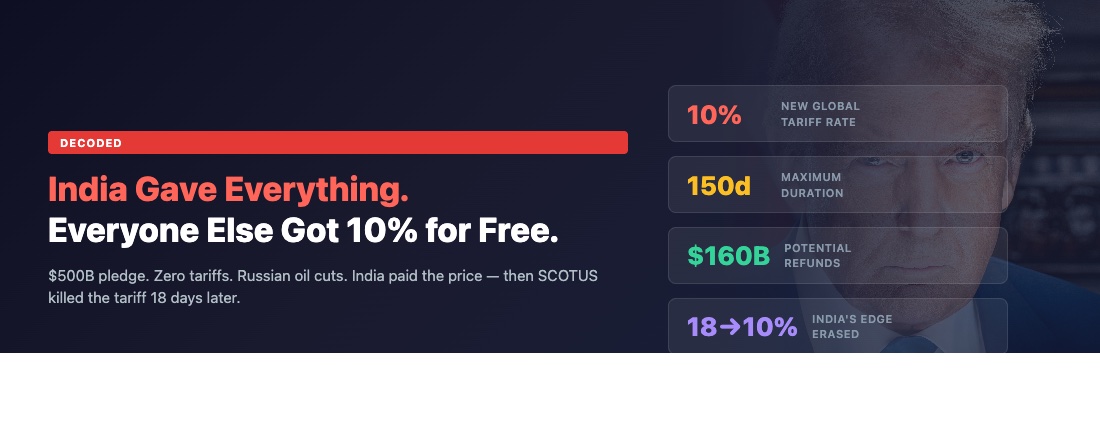
India had negotiated an 18% rate — cutting Russian oil, offering zero tariffs on $23 billion of US goods, pledging $500 billion in purchases. Now every country on Earth pays just 10%. India's carefully negotiated edge? Gone.
On February 2, India signed what the White House called a "historic trade deal". To bring its tariff down from 50% to 18%, India handed over some of its biggest strategic cards:
| India's Concession | Value/Scale | Status Post-SCOTUS |
|---|---|---|
| Zero tariffs on US goods | $23 billion worth | Still committed |
| Cut Russian oil imports | Down 40% in January already | Still committed |
| Buy $500B in US products | Over 5 years (~80% of annual budget) | Still committed |
| Remove non-tariff barriers | Agricultural, regulatory | Still committed |
Every concession stands. None can be taken back without diplomatic consequences. India committed real resources as part of the bilateral trade deal — Russian oil was already slashed 40.48% year-over-year in January. Reliance Industries completely stopped buying Russian crude. Russia's share of India's oil fell to 21.2% — the lowest since October 2022.
In return, India got an 18% tariff rate. Eighteen days later, the entire world got 10% — without giving a thing.
This is the part that stings. The Supreme Court ruling wasn't a bolt from the blue. It was the most predictable legal outcome in recent US trade history. Every trade lawyer, policy analyst, and betting market could see it coming:
| Date | Event | Signal Strength |
|---|---|---|
| May 28, 2025 | US Court of International Trade unanimously rules IEEPA tariffs illegal | Strong — unanimous lower court rejection |
| Aug 29, 2025 | US Court of Appeals affirms the ruling | Very strong — two courts now agree |
| Sep 9, 2025 | SCOTUS grants expedited consideration — a rare step signalling urgency | Case fast-tracked = high priority |
| Nov 5, 2025 | Oral arguments: 3 hours (double the normal time). SCOTUSblog: "Court appears dubious." CNN: "Deeply skeptical." | 6 to 9 justices skeptical — including Trump appointees Barrett and Gorsuch |
| Feb 2, 2026 | India signs the trade deal — gives 0% tariffs, cuts Russian oil, pledges $500B | India commits massive concessions |
| Feb 17, 2026 | Polymarket betting odds: only 25% chance tariffs survive | Markets priced it at 3-to-1 against Trump |
| Feb 20, 2026 | SCOTUS rules 6-3 against — exactly as predicted | Outcome matched consensus forecast |
Brian Jacobsen at Annex Wealth Management captured the Wall Street consensus: "It seemed like only the administration was holding out the expectation that IEEPA tariffs would be upheld."
Goldman Sachs chief US political economist Alec Phillips had noted months earlier that the ruling "represents a setback for the administration's tariff plans" but predicted Trump would find other tools — suggesting the 50% IEEPA rate was never as permanent as it seemed.
The 18-Day Question
This wasn't a 50-50 coin toss. Two lower courts had already ruled against IEEPA tariffs (see our full SCOTUS tariff ruling breakdown). During oral arguments, even Trump's own appointees — Barrett and Gorsuch — pressed the government hard on whether any statute in US history had ever granted such tariff power. The government's lawyer couldn't answer. Betting markets had it at 75-25 against Trump. Yet India signed a deal on February 2 — giving away billions — as if the 50% tariff was permanent. Whether this was a calculated bet on long-term goodwill, or a costly failure to price in a highly probable legal outcome, is a question India's trade strategists must now confront.
February 20, 2026, will be studied in trade policy textbooks. In a single day, US trade policy experienced its most dramatic whiplash since the Smoot-Hawley Act of 1930.
Markets closed up — S&P 500 gained 0.69%, Dow added 230 points — but gains were far smaller than the initial post-SCOTUS spike, reflecting uncertainty about what Trump's Plan B actually means.
India Negotiated 18%. Everyone Else Got 10% for Free.India's tariff rate has changed three times in under three weeks. Follow the math:
| Date | Tariff on India | Legal Basis | What India Gave |
|---|---|---|---|
| Before Feb 2 | 50% (reciprocal) | IEEPA | Nothing — under threat |
| Feb 2 Deal | 18% (negotiated) | IEEPA (reduced) | 0% tariffs on $23B US goods, cut Russian oil, $500B pledge |
| Feb 20 Post-SCOTUS | 0% (IEEPA voided) | None — IEEPA struck down | Nothing needed |
| Feb 20 Evening | 10% (global) | Section 122 | Nothing — applies to all equally |
A White House official confirmed to Tribune India: "Yes, 10% until another authority is invoked." India currently faces 10% under Section 122 — lower than its negotiated 18%. The deal that cost India billions in concessions now delivers a rate worse than what every other country gets for free.
52 Years. Zero Precedent. One Emergency.Section 122 of the Trade Act of 1974 was designed as an emergency brake for balance-of-payments crises. Since the law was created 52 years ago, no president — not Nixon, not Reagan, not Obama — has ever invoked it. It is being used for the first time in its entire history.
The White House fact sheet claims the US faces "fundamental international payment problems." But Section 122 is fundamentally different from the weapon the court just took away:
| Feature | IEEPA Tariffs (Struck Down) | Section 122 (New) |
|---|---|---|
| Maximum Rate | No limit (went up to 245% on China) | Capped at 15% |
| Duration | Indefinite | 150 days max |
| Extension | President alone | Requires Congress to vote |
| Investigation Needed | National emergency declaration | None — president acts unilaterally |
| Country-Specific Rates | Yes (50% India, 145% China, etc.) | No — flat rate for all |
| Revenue (10-year) | $1.4 trillion | ~$36 billion (over 150 days) |
| Ever Used Before | Yes (2025-2026) | First time ever since 1974 |
The IEEPA tariffs were a $1.4 trillion revenue machine. Section 122 generates roughly $36 billion — a fraction. The Tax Foundation estimates this wipes out nearly three-fourths of the tariff revenue Trump was counting on.
Walk Away, Renegotiate, or Hold the Line?India now faces a decision with no easy answers. The leverage that forced its concessions — a 50% IEEPA tariff — no longer exists. GTRI founder Ajay Srivastava, a former Indian Trade Service officer, warns India must reassess the deal, noting "no deal with the US is ever final." GTRI's analysis found India's concessions mirrored the one-sided terms the US extracted from smaller economies like Malaysia.
Case for Renegotiation (Trade Experts)
- GTRI (Ajay Srivastava): 18% rate is pointless when 10% applies globally. Recommends a "Zero-to-Zero" tariff deal on 90% of industrial goods. (Business Standard)
- GTRI data finding: India-US trade data has a $17.5 billion gap ($73.7B vs $91.2B) — tariff decisions may be based on inaccurate numbers.
- Goldman Sachs: The 50% threat was always temporary. India could have negotiated knowing this.
Case for Staying the Course (Industry)
- EY India (Saurabh Agarwal): "The interim pact serves as a critical stability bridge." Industry views this as "a net positive." (DNA India)
- CII (Rajiv Memani): The deal "marks a significant step forward" and will "enhance global competitiveness." (Tribune)
- Wells Fargo (Sarah House): Certainty from the ruling could lead to "modestly higher investment and job creation."
India's concrete options:
| Option | Pros | Cons |
|---|---|---|
| Keep zero tariffs | Maintains goodwill, deal could lead to better Phase 2 terms | India keeps giving without equivalent access |
| Renegotiate the rate | Match 10% global rate, demand reciprocal concessions | Risks targeted Section 301 tariffs on India |
| Reverse to pre-deal tariffs | Restores tariff revenue, signals sovereignty | Nuclear option — destroys bilateral trust |
| Propose "Zero-to-Zero" | GTRI's plan: both countries drop tariffs on 90% of industrial goods | Requires US concessions Trump hasn't offered |
Chatham House analysis suggests India will choose pragmatism: keep the deal framework intact while quietly using the SCOTUS ruling as leverage for better Phase 2 terms. Don't expect a dramatic reversal — expect quiet recalibration.
The 10% tariff automatically expires on or around July 24, 2026 — 150 days from the February 24 effective date. But don't count on relief. Three scenarios are in play:
| Scenario | How It Works | Likelihood |
|---|---|---|
| 1. Congress Extends | Congress votes to continue tariffs. Trump: "I would ask Congress, and probably get it." | Medium — midterm politics |
| 2. The "Reset Loophole" | Let tariffs expire, immediately declare a new emergency, restart the 150-day clock. Nothing in the statute forbids this. | High — Cato Institute warns this is most likely |
| 3. Section 301 Takes Over | Trump's USTR has launched "accelerated" Section 301 investigations — country-specific tariffs within months. | High — the long-term play |
The Verdict on 150 Days
The Council on Foreign Relations puts it bluntly: the 10% is a bridge, not an endpoint. Section 301 investigations are already underway. The tariff train has not stopped — it's just changed tracks.
Here's something most people missed. The SCOTUS ruling didn't just stop future tariffs — it potentially unlocked $160-175 billion in refunds to US importers who already paid IEEPA tariffs.
The Penn Wharton Budget Model puts the collected amount at over $160 billion. The Committee for a Responsible Federal Budget estimates the ruling could add $2.4 trillion to the national debt over the next decade — between lost tariff revenue and potential refunds.
But don't expect cheques in the mail. The Supreme Court said nothing about how or when refunds should happen. The Court of International Trade would manage the process, and CNBC reports any rush for refunds could overwhelm the system and lead to years of delays.
10% Is the Floor, Not the CeilingThe 10% global tariff is not Trump's final move. It's a placeholder. The administration has signalled a multi-track strategy:
| Track | Tool | Timeline | Likely Targets |
|---|---|---|---|
| Immediate | Section 122 (10% global) | Feb 24 - July 24 | All countries (except USMCA) |
| Short-Term | Section 301 Investigations | Months | China, India, EU, Brazil — "accelerated" |
| Medium-Term | Congressional Tariff Bills | 3-6 months | Permanent tariff authority for president |
| Existing | Section 232 (Steel/Aluminium) | Already in effect | India (25%), all countries |
| Bilateral | Country-specific negotiations | Ongoing | India, UK, EU, Japan, South Korea |
As Brian Jacobsen of Annex Wealth Management put it: "The administration will pivot to country-specific and sector-specific tariffs. Those take longer to impose, but they are likely coming."
The Bottom Line
India gave zero tariffs on $23 billion of US goods, slashed Russian oil by 40%, and pledged $500 billion in purchases — all to bring its rate from 50% to 18%. Eighteen days later, the Supreme Court killed the very tariff that made those concessions necessary. Now every country pays 10%, and India's deal rate is 8 points higher than the global floor. The concessions can't be taken back. The 150-day clock is ticking, but the real question isn't whether tariffs end — it's which new mechanism replaces them. India's negotiators — already navigating a delicate balancing act in the Middle East — must decide: lock in the deal's strategic value, or use the SCOTUS ruling to demand better terms. The tariff era isn't over. It just changed shape.