February 2 — Trump announces tariffs on India slashed from 50% to 18%. The condition: India stops buying Russian oil. Modi "agrees."
February 28 — US and Israel launch strikes on Iran. The Strait of Hormuz, through which 40% of India's crude flows, begins shutting down.
March 6 — Business Today reports: Russian oil is back. But at full market price. No discounts.
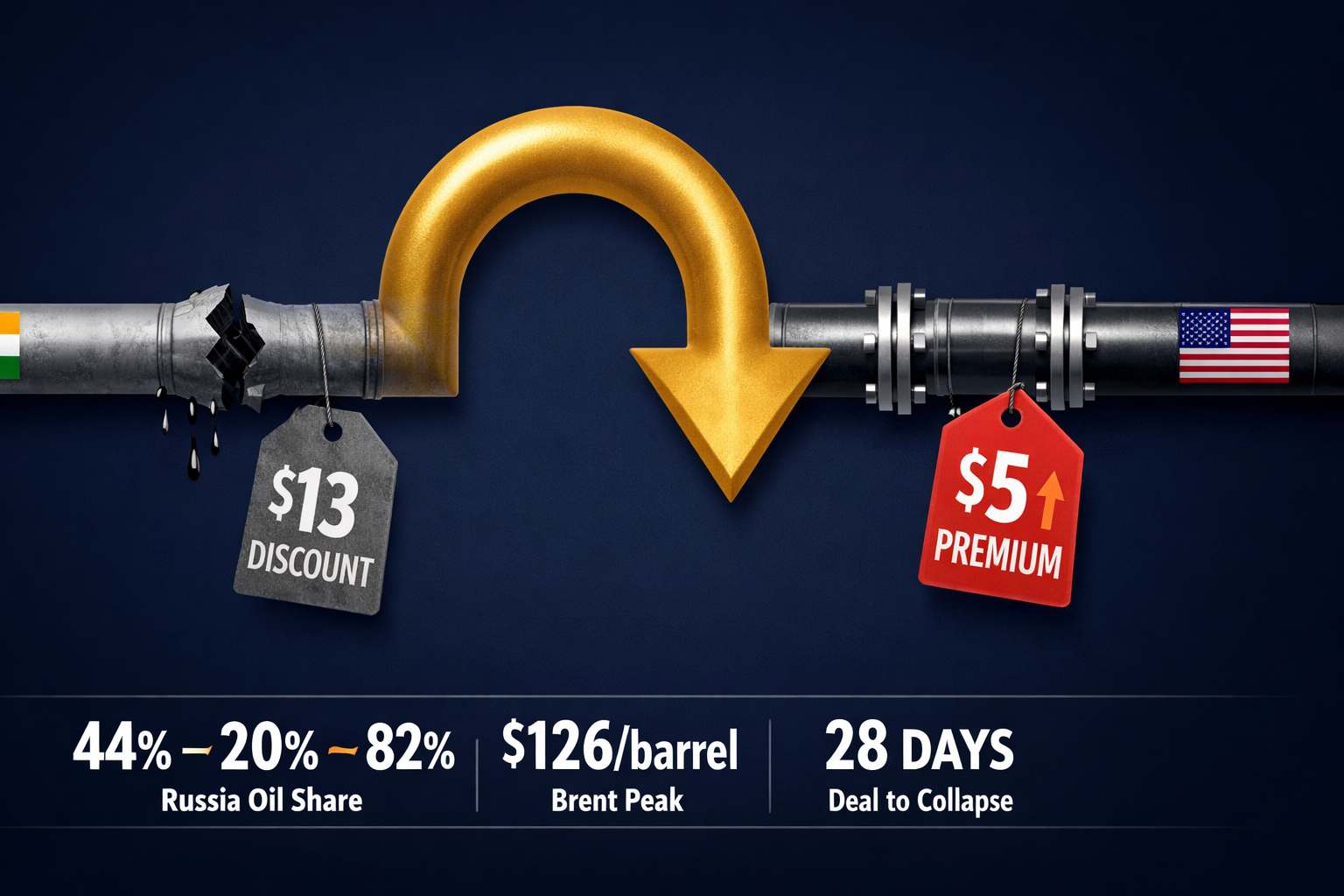
March 16 — Bloomberg reports Russian Urals crude delivered to India hits a record $98.93 per barrel. The old $13 discount has become a $5 premium.
March 25 — Treasury Secretary Bessent tells Fox Business: "We have given India permission to accept the Russian oil."
In less than a month, the geopolitical ground beneath India's energy strategy collapsed. A deal designed to pull India away from Russian oil was undone by the very war its main partner started. And when India was told it could go back to buying Russian crude, the terms had fundamentally changed.
This isn't just an oil story. It's a case study in what happens when a country trades strategic leverage for a tariff reduction — and the leverage disappears overnight.
What India Gave. What India Got.On February 2, 2026, President Trump announced the US would cut tariffs on Indian goods from 50% to 18%. The 50% rate had been artificially inflated — it included a 25% punitive tariff specifically imposed to stop India from buying Russian oil.
In exchange, according to Trump's Truth Social post, Modi agreed to: stop buying Russian oil, replace it with American and Venezuelan crude, reduce Indian tariffs on US goods to zero, remove non-tariff trade barriers, and invest $500 billion in American energy, technology, and agriculture.
There was one problem. Modi never publicly confirmed the Russian oil pledge. NBC News, Carnegie Endowment, and The Print all noted that India's official statements welcomed the tariff reduction but did not mention cutting Russian crude purchases.
From $13 Discount to $5 Premium. The Math That Changed.Between 2023 and early 2026, India was the biggest beneficiary of Western sanctions on Russia. Russian oil was toxic to European buyers, so Moscow sold to India at massive discounts — $10 to $13 per barrel below Brent. At peak, Russia supplied 44% of India's crude imports.
Under tariff pressure from Trump, India began reducing purchases. Russia's share dropped from 44% in June 2025 to 20% by February 2026. The deal appeared to be working.
Then Hormuz closed.
| Period | Russia's share of India's imports | Price vs Brent |
|---|---|---|
| June 2025 (peak) | 44.4% | $10-13 discount |
| February 2026 (post-deal) | 20% | Near parity |
| March 2026 (post-Hormuz) | 82.3% surge | $4-5 premium |
The Sunday Guardian captured the swing perfectly: "From $13 Discount to Premium." India bought 60 million barrels of Russian oil for April delivery — more than double February levels — at premiums of $5 to $15 per barrel above Brent. Russia, no longer desperate for buyers in a $126/barrel market, simply refused to offer discounts.
The Permission Slip Nobody Asked For.On March 25, US Treasury Secretary Scott Bessent told Fox Business: "To ease the temporary gap of oil around the world, we have given India permission to accept the Russian oil." A 30-day sanctions waiver followed.
The irony was lost on no one. The US had spent months pressuring India to stop buying Russian oil. It had imposed 50% tariffs to enforce the demand. It had extracted a $500 billion investment pledge and a promise of zero tariffs on American goods. And now it was "permitting" India to do exactly what it had punished India for doing — except India was now paying $18 more per barrel than it had been paying six months ago.
CNN's headline captured it: "Trump wanted India off Russian oil. His war with Iran is now undermining that goal."
40 Countries. Zero Leverage.The Indian government's defense has centered on diversification. The Ministry of Petroleum noted that India now sources crude from about 40 countries, up from 27 in 2006-07, and that 70% of imports have been rerouted away from Hormuz-dependent routes.
On paper, this sounds like resilience. In practice, it's the opposite of leverage.
When India had two primary suppliers offering steep discounts — Russia desperate for non-Western buyers, and historically friendly Gulf states on long-term contracts — India was a strategic buyer. It had pricing power because its suppliers needed it more than it needed any single one of them.
Now, buying from 40 countries at market price, India is a price-taker. Angola, Brazil, and Guyana don't offer discounts to India. They have plenty of other buyers. Diversification protects supply but destroys pricing power. It's the difference between a wholesale buyer getting bulk rates and a retail customer shopping at 40 different stores — all charging MRP.
Government's Defense
- "We will make independent choices" — Jaishankar, Feb 2026
- Diversified to 40 countries, 70% imports rerouted off Hormuz
- PM Modi called for "lesser dependence on imported energy" (Bloomberg)
- Emergency review with Shah + Jaishankar — "Team India" approach
What Critics Say
- "Strategic surrender" — India gave up leverage, got a tariff rate it shouldn't have been charged (National Herald)
- "Alignment by default, not independence by design" — ECPR
- "Strategic autonomy has become a liability" — Asia Times
- India's current account deficit could hit 2.7% of GDP if oil stays above $100 (Bernstein)
India is trapped in an uncomfortable position. The 18% tariff deal still stands, but its central condition — no Russian oil — has been openly abandoned by both sides. The $500 billion investment pledge remains on paper. And the Chabahar port waiver with Iran expires in April 2026, with the US unlikely to extend it, meaning India's last strategic foothold with Tehran is also disappearing.
The Bessent waiver is for 30 days. If Hormuz stays disrupted beyond that, India faces a choice: keep buying Russian oil without US permission (and risk the tariff going back to 50%), or accept a permanent restructuring of its energy costs at premium rates.
Meanwhile, Russia has learned the lesson of 2023-25: India is not a loyal customer, it's an opportunistic one. The era of desperate discounts for Indian refineries is over. Every future barrel will be priced accordingly.
The Bottom Line
India traded a $13-per-barrel oil discount, its Iran relationship, and zero-tariff flexibility for an 18% tariff rate that was artificially inflated to begin with. Twenty-eight days later, the deal's central premise collapsed, and India ended up buying the same Russian oil at record prices — with American "permission." Diversification to 40 suppliers sounds like a plan. But having 40 suppliers at market price is not the same as having 2-3 suppliers competing to give you the best deal. India went from being a strategic buyer with leverage to a price-taker in an open market. The U-turn happened. The damage didn't un-happen.