1966: Motion against Speaker Hukam Singh. Failed.
1987: Motion against Speaker Balram Jakhar. Failed.
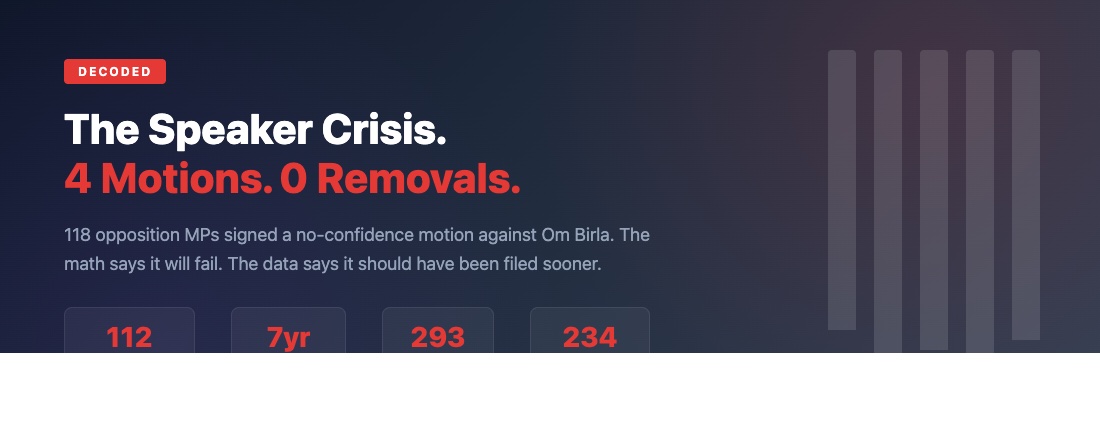
2026: Motion against Speaker Om Birla. 118 signatures. 10-hour debate allotted. Result?
In 76 years of Indian parliamentary democracy, no Lok Sabha Speaker has ever been removed. The Constitution makes it almost impossible. The ruling party's numbers always protect the Chair. So why are 118 MPs doing something they know will fail?
Because sometimes, the point isn't the vote. It's the record.
The Lok Sabha Speaker is not a ceremonial post. The Speaker decides who speaks, for how long, on what topics, and whether your microphone stays on. The Speaker controls which bills get debated, which amendments get admitted, and which MPs get suspended for "disrupting proceedings." In a parliamentary system, the Speaker is the single most powerful gatekeeper of democratic debate.
Article 94 of the Constitution allows the Speaker to be removed — but only through a resolution passed by an effective majority: more than half of the total membership of the House. Not those present and voting. Total. That means 272 out of 543.
The NDA has 293 seats. The opposition INDIA bloc has 234. The gap is 38 votes — a margin the opposition cannot close without defections from the ruling alliance. This is why the motion is mathematically dead before the debate begins.
The motion will fail. Everyone knows it. But strip away the vote count, and the data behind the opposition's complaint is harder to dismiss.
Under Om Birla's first term as Speaker (2019-2024), 112 opposition MPs were suspended from the Lok Sabha. According to a data investigation by The Quint, this is the highest number under any Speaker in the past 20 years. Birla presided over nearly half of all suspension actions recorded since 2004.
The single most extraordinary episode came in December 2023. Over one week during the Winter Session, 100 opposition MPs were suspended — the largest mass suspension in the history of India's Parliament. The MPs had been protesting to demand a government statement on a security breach inside the Parliament building. That one episode alone accounted for over 40% of all Lok Sabha suspensions since 2004.
| Metric | Om Birla (2019-24) | Previous 20 Years Combined |
|---|---|---|
| Total MP suspensions | 112 | ~130 |
| Single largest suspension event | 100 MPs in 1 week | 25 MPs (previous record) |
| Ruling party MPs suspended | 0 | Varies |
| Deputy Speaker elected | No | Yes (every term) |
The no-confidence motion didn't emerge from abstract constitutional principle. It was triggered by a specific sequence of events in the Budget Session that the opposition calls a textbook case of selective rule enforcement.
Beyond this February episode, the opposition's broader allegations include: the Leader of the Opposition allegedly denied permission to speak 20 times; opposition microphones routinely muted mid-sentence; TMC MP Mahua Moitra stating the Speaker "perfected the art of turning off microphones for opposition MPs"; and Sansad TV (Parliament's official channel) accused in 2023 of not showing INDIA alliance members when they were speaking.
4 Times in 76 Years. Zero Precedent. One Outcome.To understand why this motion is structurally doomed, you need to understand how the Constitution designed the removal process — and why it has never worked.
| Year | Speaker Targeted | Moved By | Outcome |
|---|---|---|---|
| 1954 | G.V. Mavalankar | Socialist MP Vigneshwar Misir + 21 MPs | Defeated |
| 1966 | Sardar Hukam Singh | Opposition members | Defeated |
| 1987 | Balram Jakhar | Opposition members | Defeated |
| 2026 | Om Birla | 118 INDIA bloc MPs | Debate ongoing |
The procedure under Article 94(c) requires:
1. Notice: A written resolution must be submitted to the Secretary-General at least 14 days in advance.
2. Support: At least 50 MPs must stand in support for the motion to be admitted.
3. Specificity: Under Rule 200A, the resolution must be "specific in its charges, clearly and precisely worded, and free of arguments, inferences, ironic expressions, imputations, or defamatory statements."
4. Vote: Requires an effective majority — 272 out of 543 members.
5. The Speaker's role: The Speaker cannot preside during the debate but can participate and vote (except in a tie).
The design is intentional. The Constituent Assembly wanted the Speaker's office to be stable and insulated from routine political attacks. The threshold is set high enough that only a genuine cross-party consensus — or a fractured ruling coalition — could achieve removal. Neither condition exists today.
293 vs 234. The Arithmetic That Decides Everything.| Alliance | Seats (2024) | Key Parties |
|---|---|---|
| NDA (Ruling) | 293 | BJP (240), JD(U) (12), TDP (16), others |
| INDIA Bloc (Opposition) | 234 | Congress (99), SP (37), TMC (29), DMK (22), others |
| Others / Unaligned | 16 | Independents, smaller parties |
| Removal threshold: 272 votes needed. Opposition shortfall: 38 votes. | ||
Even if every INDIA bloc member votes for removal, the opposition would need 38 NDA members to defect. For context, the NDA's two largest allies — TDP (16 seats) and JD(U) (12 seats) — would both need to flip entirely, plus additional defections. In the current political climate, with no anti-defection incentive and strong coalition discipline, this is functionally impossible.
So Why Do It?
Three strategic reasons. First, the 10-hour debate creates an official parliamentary record of every allegation — microphone muting, selective suspensions, rule manipulation — that cannot be erased or denied. Second, it forces every NDA MP to vote publicly in defense of the Speaker's record, creating accountability that can be referenced in future elections. Third, it establishes constitutional precedent — if these practices worsen, the record shows the opposition used every legal tool available.
Opposition's Case: "The Record Speaks"
- 112 suspensions in one term — a 20-year record, all from opposition benches
- 100 MPs in one week — largest mass suspension in Indian parliamentary history
- Leader of Opposition denied speaking 20 times — unprecedented treatment of the principal opposition voice
- 7 years without Deputy Speaker — violates convention that opposition holds this post
- Selective rule enforcement — Rules 349/353 applied to Gandhi, not to Dubey for same conduct
- Microphone muting — "perfected the art" of silencing opposition mid-sentence
Government's Case: "Disruption Has Consequences"
- Suspensions followed disruptions — MPs were blocking proceedings, not engaging in debate
- All members must follow the Chair — the Speaker's authority is institutional, not personal
- "Only for headlines" — TDP MP called the motion political theater designed for media coverage
- BJP never brought such a motion — Kiren Rijiju: "Even in the Cash-for-Vote scandal, we didn't bring a no-confidence motion"
- Speaker has been impartial — NDA MPs laud Birla's contributions to parliamentary efficiency
- Opposition creates disorder, then blames the Chair — disruption is the cause, suspension is the effect
The 10-hour debate was allotted starting March 10. BJP MP Jagdambika Pal presides (since Birla cannot chair his own removal proceedings). Home Minister Amit Shah is expected to address the House in defense of the Speaker. Congress MP Gaurav Gogoi opened for the opposition, stating the resolution was to "safeguard parliamentary dignity" and was "not driven by personal animosity."
When the vote comes — and it will fail — the immediate political aftermath is predictable. The NDA will call it a vindication. The opposition will say they put the record straight. News cycles will move on within 48 hours.
But the institutional damage is slower and harder to measure. Each mass suspension normalizes the next one. Each muted microphone lowers the bar for the Chair after Birla. The precedents being set now will outlive this Parliament.
Plot Twist: The Bigger Constitutional Crisis Nobody Talks AboutBuried in the noise of the no-confidence motion is a constitutional anomaly that may be more damaging than anything the Speaker has done: India has not had a Deputy Speaker since June 19, 2019.
That's seven years. Two full Lok Sabha terms. This has never happened before in India's parliamentary history.
By convention, the Deputy Speaker's post goes to the opposition — it's a built-in check on the Speaker's power, ensuring that an opposition representative can preside over proceedings and provide balance. The 17th Lok Sabha (2019-2024) completed its entire five-year term without electing a Deputy Speaker. The 18th Lok Sabha, elected in 2024, has continued the vacancy.
The previous longest gap was 270 days during the 12th Lok Sabha — less than one year. The current vacancy is nine times longer.
Step back from the personalities — Birla, Gandhi, Rijiju — and the picture shifts. The no-confidence motion is not really about one Speaker. It's about a structural weakness in Indian parliamentary democracy that has been exposed over two decades.
The Speaker is elected by simple majority — meaning the ruling party always picks one of its own. The removal threshold is set at effective majority — meaning the ruling party always protects the Speaker. The Deputy Speaker convention (opposition representation) has no legal enforcement — meaning the ruling party can simply choose not to elect one. The result is a system where the referee is chosen by one team, protected by that team's numbers, and the opposing team has no deputy referee as backup.
This isn't unique to the BJP or the NDA. Congress Speakers have faced similar allegations from BJP oppositions in previous Parliaments. The structural incentive is bipartisan: whichever party holds the majority has every reason to maximize the Speaker's discretionary power and minimize opposition oversight.
What's different in 2019-2026 is the scale: 112 suspensions vs the previous two-decade average, a record mass suspension, and the first-ever seven-year Deputy Speaker vacancy. The tools have always existed. They've simply never been used this aggressively.
The Bottom Line
The no-confidence motion against Speaker Om Birla will fail. The NDA's 293 seats vs the opposition's 234 make the outcome a mathematical certainty. No Lok Sabha Speaker has ever been removed in 76 years, and Om Birla will not be the first.
But "it will fail" is not the same as "it doesn't matter." The 10-hour debate creates a permanent parliamentary record of 112 suspensions, selective rule enforcement, muted microphones, and a 7-year Deputy Speaker vacancy — data that cannot be dismissed as opposition noise. The real crisis isn't that the Speaker is partisan. It's that the Constitution's design guarantees that every Speaker can be, with no effective remedy available to the opposition. This motion won't fix that. Nothing short of structural reform will.
No. In 76 years, no-confidence motions have been moved 4 times (1954, 1966, 1987, 2026) and all have failed. The effective majority requirement (272 out of 543) makes removal virtually impossible when the ruling party controls the House.
What is the difference between effective majority and simple majority?Simple majority requires more than half of those present and voting — if 100 members are absent, the threshold drops. Effective majority requires more than half of all members regardless of attendance — the threshold is always 272. This higher bar applies to Speaker removal (Article 94) but not to no-confidence motions against the government (Article 75).
Can the Speaker be removed without a vote?No. Article 94(c) is the only constitutional mechanism. The Speaker cannot be removed by executive order, judicial intervention, or any process other than a House resolution passed by effective majority. Even the President cannot remove the Speaker.
Why hasn't India had a Deputy Speaker since 2019?By convention (not law), the Deputy Speaker post goes to the opposition. The ruling NDA has not facilitated the election for two consecutive terms. There is no constitutional deadline or enforcement mechanism — making it a convention the government can ignore without legal consequence, even if it undermines parliamentary checks and balances.