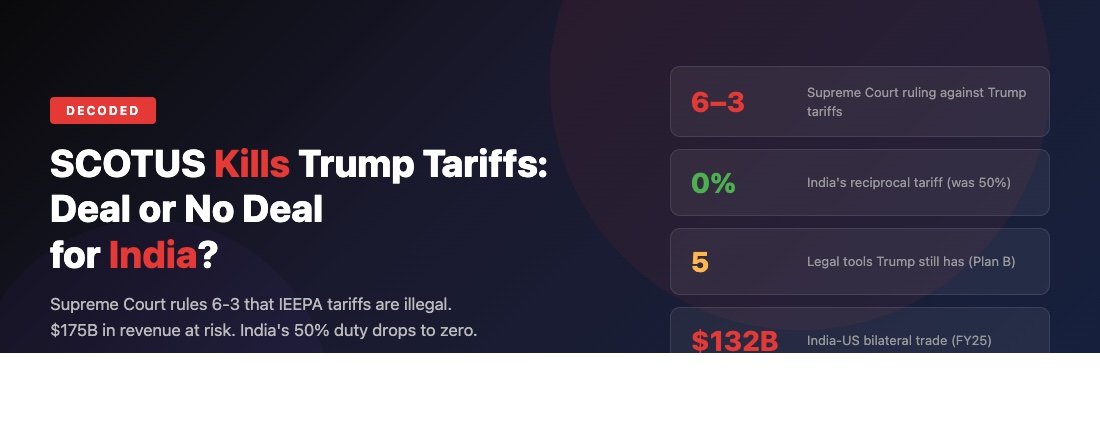
The Numbers Behind the Ruling
6–3 Supreme Court justices who ruled Trump's tariffs are illegal
$175 Billion+ Total tariff revenue collected — now at risk of being refunded
90+ Countries Affected by the ruling, including India, China, Canada, Mexico, and the EU
On February 20, 2026, the US Supreme Court delivered what may be the most consequential economic ruling of the decade. In a 6-3 decision, Chief Justice John Roberts wrote that President Trump had overstepped his authority by using the International Emergency Economic Powers Act (IEEPA) — a 1977 law designed for genuine national emergencies — to impose sweeping tariffs on goods from nearly every country on Earth.
Roberts was blunt: "It is telling that in IEEPA's half century of existence, no President has invoked the statute to impose any tariffs, let alone tariffs of this magnitude and scope." The court ruled that IEEPA, which allows the president to "regulate importation" during emergencies, was never intended to give the executive branch the power to levy taxes — something the Constitution reserves for Congress.
Justices Clarence Thomas, Samuel Alito, and Brett Kavanaugh dissented, arguing the law's language was broad enough to encompass tariffs. But the 6-3 majority was decisive: the IEEPA tariff weapon is dead. Permanently.
What Exactly Was Struck Down?
All "reciprocal" country-by-country tariffs (10–50% on 90+ nations), the 25% tariff on Canada/Mexico/China for "fentanyl," and the 25% Russian oil penalty tariff on India. What still stands: Section 232 tariffs on steel (50%), aluminium (50%), autos (25%), and some auto parts — these use a different legal authority.
For India, the tariff saga has been nothing short of a geopolitical rollercoaster. What started as "reciprocal trade" quickly became entangled with Russian oil, defence purchases, and a high-stakes bilateral trade deal. Here's how it unfolded:
This is where it gets interesting for India. The February 2 trade deal was essentially a transaction: India makes concessions, Trump lowers tariffs. Here's what India was supposed to give up:
| India's Concession | In Exchange For | Status After SCOTUS |
|---|---|---|
| Stop buying Russian oil | Remove 25% oil penalty tariff | Tariff voided by court anyway |
| Buy $500B+ in American products | Lower reciprocal tariff: 25% → 18% | Tariff voided by court anyway |
| Open market to US medical devices | Part of deal framework | Still on the table |
| Remove ICT import licensing barriers | Part of deal framework | Still on the table |
| Open agriculture market to US products | Part of deal framework | Still on the table |
| Reduce tariffs to zero (long-term) | Part of bilateral trade agreement | Still on the table |
The Global Trade Research Initiative (GTRI) immediately recommended that India review the entire trade deal. Their logic is simple: the two biggest concessions India was making — stopping Russian oil and committing to buy American — were in exchange for tariff relief that the Supreme Court has now delivered for free.
As GTRI puts it: the removal of reciprocal tariffs frees about 55% of India's exports to the US from the 18% duty, leaving them subject only to standard Most Favoured Nation (MFN) tariffs under global trade rules.
Why India Should Renegotiate
- The two biggest concessions (Russian oil, buy American) were paying for relief the court already gave
- 55% of India's exports to US are now free from reciprocal tariffs
- India holds a strong $40.8 billion trade surplus — leverage in negotiations
- GTRI recommends a full review of the deal terms
Why India Should Stay at the Table
- Trump still has legal tools to reimpose tariffs (Section 232, 301)
- Walking away could damage the broader strategic relationship
- Market access reforms (medical devices, agriculture) benefit India too
- Section 232 tariffs on steel/aluminium at 50% still hurt Indian exporters
Perhaps the most fascinating subplot in this saga is India's masterclass in strategic ambiguity on Russian oil.
Here are the facts: Trump announced on February 2 that Modi had "committed" to stop buying Russian oil and replace it with American and Venezuelan crude. He posted on social media that Modi agreed to "BUY AMERICAN, at a much higher level."
But here's what actually happened:
Modi's post on X welcomed the reduced tariffs but did not mention Russian oil. The official US-India joint statement also did not mention Russian oil. And on February 20 — the same day as the SCOTUS ruling — India's Ambassador to Russia, Vinay Kumar, confirmed that India will continue buying Russian oil.
The numbers tell the story: India's Russian oil imports have been declining naturally — from a peak of 1.5 million barrels per day down to roughly 1.2 million in January, with projections of 800,000 barrels per day by March. This gives India plausible cover to claim partial compliance without ever having explicitly agreed to anything.
As Chatham House noted: despite the reset in India-US relations, New Delhi retains its commitment to strategic hedging. Translation: India keeps all its options open.
Is It Really Over? Trump's Five Remaining Legal WeaponsTrump called the ruling "a disgrace" and immediately declared he has a "backup plan." Treasury Secretary Scott Bessent and Commerce Secretary Howard Lutnick had reportedly prepared contingency plans before the ruling even came down. So is this really game over?
The short answer: no. Trump has at least five legal pathways to reimpose tariffs. But every single one is slower, more limited, and more legally vulnerable than the IEEPA route the Supreme Court just killed.
| Legal Tool | Max Rate | Timeline | Limitations |
|---|---|---|---|
| Section 122 Trade Act of 1974 |
15% | Immediate | Expires in 150 days; trade deficit justification only |
| Section 338 Tariff Act of 1930 |
50% | Fast | Never been used in history; legal challenges expected |
| Section 232 Trade Expansion Act 1962 |
No cap | ~270 days | Requires Commerce Dept investigation proving national security threat |
| Section 301 Trade Act of 1974 |
No cap | Months | Requires USTR investigation; must prove unfair trade practices |
| Congressional legislation | Any | Months to years | GOP divided on tariffs; Senate already rebuked Canada tariffs; bipartisan support needed |
The fastest option is Section 122, which lets the president impose tariffs to address trade deficits — but with two critical limits: rates are capped at 15% and they expire after 150 days. Compare that to the 50% India was facing under IEEPA. It's a band-aid, not a replacement.
The Nuclear Option: Section 338Section 338 of the Tariff Act of 1930 allows tariffs up to 50% based on trade discrimination, but here's the catch: it has never been used in history. If Trump invokes it, legal challenges are virtually guaranteed — and after today's ruling, courts will scrutinise executive tariff authority more aggressively than ever.
The Slow Burn: Section 232 and Section 301Both of these statutes give the president broad tariff powers, but they require formal investigations first. Section 232 needs a Commerce Department probe that takes up to 270 days. Section 301 requires the US Trade Representative to conduct a fact-finding investigation proving unfair trade practices. Neither can be invoked overnight.
The Congressional Route: UnlikelyCongress has the constitutional authority to impose tariffs — that's exactly what the Supreme Court reaffirmed today. But the Republican caucus is deeply divided on tariffs. A small group of House Republicans recently joined Democrats to overturn Trump's 35% tariff on Canada. Senate support for broad tariffs is even weaker. Speaker Mike Johnson said Congress would "determine the best path forward in the coming weeks" — but actually passing legislation is a different story.
The Real Score: Is It Really Over?
India-US trade has been on a remarkable upward trajectory despite the tariff chaos. Here's where things stand:
| Metric | Figure | Context |
|---|---|---|
| Bilateral trade (FY25) | $132.2 billion | Record high |
| India's trade surplus | $40.8 billion | India exports more than it imports from US |
| India's exports to US (FY25) | $86.5 billion | Up from $77.5B in FY24 |
| Exports freed by SCOTUS ruling | ~55% | Now subject only to MFN rates |
| Top Indian exports | Engineering goods, electronics, pharmaceuticals (51% of total) | |
| Tariff revenue at risk of refund | $175 billion+ | Across all affected countries |
| Sensex reaction | +316 points | Markets rallied on the ruling |
| Projected bilateral trade (FY27) | $300 billion | PHDCCI estimate |
India's negotiation team is reportedly heading to Washington this weekend to finalise the trade deal text. The SCOTUS ruling changes their brief dramatically. Here's what trade experts recommend:
1. Renegotiate from strength, not desperation. The February 2 deal was struck when India was under 50% tariff pressure. That pressure is now gone. India should reassess which concessions are still worth making and which were purely tariff-driven.
2. Don't walk away entirely. Despite the tariff relief, India still faces 50% duties on steel and aluminium under Section 232. A constructive engagement with the US can address these and prevent new tariff actions under other statutes.
3. Keep the Russian oil ambiguity. India never explicitly committed to stopping Russian oil purchases, and the tariff penalty for it has been voided. Natural market forces are already reducing imports. India can maintain its strategic relationships with both the US and Russia without making binding promises.
4. Push for Section 232 relief. With the IEEPA tariffs gone, the biggest trade barrier for India is the 50% steel and aluminium tariff. India should make this a priority in negotiations — especially since these tariffs hurt American manufacturers too by raising input costs.
5. Prepare for Plan B. Trump's administration has already invoked Section 122 for a 10% global tariff and made clear they will try to reimpose tariffs through other legal channels. India should prepare for the possibility of Section 301 or Section 232 investigations targeting Indian trade practices. Building goodwill through selective market-opening measures is sound strategy.
The Bottom Line
The Supreme Court has fundamentally changed the tariff landscape. India got the relief it was negotiating for — without paying the price. The IEEPA weapon is dead permanently, and no president can ever again impose overnight tariffs on entire countries using "emergency powers."
But this is not the end of the story. Trump has backup options, even if they're slower and more limited. Steel and aluminium tariffs still bite. And the broader US-India trade relationship — worth $132 billion and projected to reach $300 billion — is too important for either side to walk away from.
The real question isn't whether the tariffs are dead (they largely are). It's whether India uses this moment to renegotiate from a position of strength, or gives away concessions for relief it no longer needs. The negotiation team heading to Washington this weekend holds the answer.