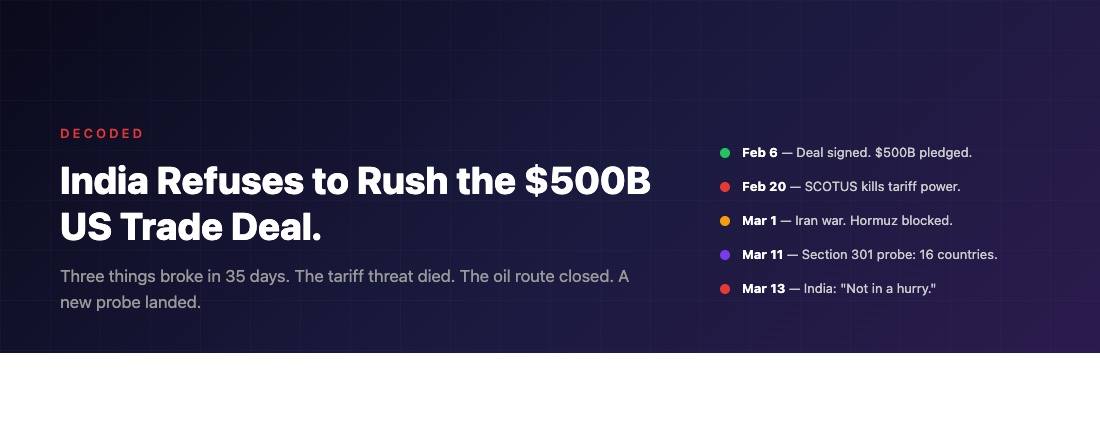
February 6: Joint statement signed. India commits to $500B in purchases, zero tariffs on US goods, stopping Russian oil.
February 20: Supreme Court kills Trump's tariff authority. The 50% threat that forced the deal? Unconstitutional.
March 1: US bombs Iran. Strait of Hormuz shuts. India's oil lifeline — gone. Russian crude becomes essential, not optional.
March 11: US launches Section 301 probe on 16 countries including India. New tariffs possible on steel, solar, autos.
March 13: India tells the US: "We are not in a hurry to sign any deal."
The White House fact sheet from February 6 reads like a wish list for Washington. India offered concessions across almost every category of trade — energy, agriculture, digital, industrial — in exchange for one thing: bringing its tariff rate down from a punishing 50% to 18%.
| What India Committed | Scale | Status Now |
|---|---|---|
| Buy $500B in US products | Over 5 years — energy, tech, coal, aircraft | Under review |
| Stop Russian oil imports | Was 1.7M barrels/day in 2024 | Impossible (Hormuz blocked) |
| Eliminate tariffs on US industrial goods | Covers all US industrial exports | Not yet implemented |
| Reduce tariffs on US agriculture | Soybean oil, wine, tree nuts, DDGs, sorghum | Not yet implemented |
| Negotiate digital trade rules | Address "discriminatory" tech regulations | Talks paused |
| Address non-tariff barriers | Agricultural, regulatory access | Talks paused |
Here's the context that makes the $500 billion number striking: India's entire annual government budget is $590 billion. The pledge to buy $500 billion in US goods over five years works out to $100 billion per year — roughly 17% of the national budget, every year, for five years. Analysts at Business Standard called the pledge "ambitious" and noted it may not be immediately realizable.
In return, the US cut India's tariff from 50% to 18%. That's the deal. India gave away Russian oil security, opened its agricultural markets, committed to half a trillion dollars in purchases, and agreed to rewrite digital trade rules — all for a 32 percentage point tariff reduction.
The deal framework was signed on February 6. By March 13, every foundational assumption behind it had collapsed. Here's what happened, in order.
Break #1: The Supreme Court Killed the Tariff Threat (Feb 20)On February 20, the US Supreme Court ruled 6-3 that President Trump did not have the legal authority to impose tariffs under the International Emergency Economic Powers Act (IEEPA). Chief Justice Roberts wrote that "trade deficits are not national emergencies."
This matters because the entire India deal was built on IEEPA tariff pressure. The 50% tariff that India was desperate to reduce? IEEPA. The 25% additional tariff that was removed as a sweetener? IEEPA. The legal foundation of the threat that forced India to the table was, it turns out, unconstitutional.
As the Peterson Institute for International Economics noted, the ruling means countries that struck deals under IEEPA pressure may now "slow-walk complying with the terms of those deals, many of which were reached under administration pressure more akin to extortion."
Trump did switch to Section 122 tariffs the same day — but at 10% globally, applied equally to all countries. India's negotiated 18% rate is now higher than the global floor. (We covered the full Section 122 story in our earlier Decoded analysis.)
Break #2: Iran War Made Russian Oil Essential (Mar 1)A key condition of the deal was India stopping Russian oil imports. In January, India had already cut Russian oil purchases by 40.48% year-over-year. Reliance Industries had completely stopped buying Russian crude. The commitment appeared achievable.
Then on March 1, the US launched military operations in Iran. Iran closed the Strait of Hormuz — the shipping channel through which 20% of the world's oil supply and roughly 40% of India's Middle Eastern oil imports pass. Brent crude surged past $100 per barrel.
Overnight, Russian oil went from a diplomatic liability to an energy lifeline. India imports 88% of its crude oil. With the Middle Eastern route blocked, Russian crude — which can reach India via the northern and Pacific routes — became indispensable. As analysts at CNBC reported, India now has room to maintain 800,000 to 1 million barrels per day from Russia.
The irony is thick: a US military operation in the Middle East made it physically impossible for India to honour the US trade deal's oil condition.
Break #3: Section 301 Probe Targeted India (Mar 11)On March 11, the US Trade Representative announced Section 301 investigations into 16 economies — including India — for "structural excess capacity and production in manufacturing sectors."
Section 301 is one of America's most powerful trade weapons. It was the same legal tool used to impose tariffs on $370 billion of Chinese goods in 2018. The investigation targets 21 manufacturing sectors:
| Sector Category | Sectors Under Investigation | India's Exposure |
|---|---|---|
| Metals | Steel, aluminum, non-ferrous metals | High — India's steel exports jumped 36.6% this year |
| Energy/Green | Solar modules, batteries, energy goods | High — India's solar manufacturing is growing rapidly |
| Chemicals | Petrochemicals, chemicals, plastics | Medium — significant export sector |
| Transport | Automobiles, ships, transportation equipment | Medium — auto component exports growing |
| Textiles | Textiles (listed separately by India sources) | High — India is a major textile exporter |
| Technology | Semiconductors, electronics, robotics, satellites | Low — India imports more than it exports |
| Other | Cement, glass, machine tools, paper, food & beverages | Varies |
The timing is what spooked New Delhi. India was supposed to start reducing tariffs on US goods "after mid-March." Then, days before implementation, the US launched a probe that could result in additional tariffs on Indian exports. An Indian government source told Business Today that the probe is a "pressure tactic to force countries into signing deals after the court order."
$58.2 Billion. That's the Deficit the US Wants to Fix.To understand why the US is pushing so hard, look at the numbers:
| Metric | 2024 | 2025 | Change |
|---|---|---|---|
| US goods exports to India | $41.5B | $45.6B | +9.8% |
| US goods imports from India | $87.3B | $103.8B | +18.9% |
| US trade deficit with India | $45.8B | $58.2B | +27.1% |
| US services trade with India | $83.4B (2024) | — | |
The US trade deficit with India grew by $12.4 billion in a single year — a 27.1% jump. That's not a number any US administration can ignore, regardless of party. For context, only China ($202B) and the EU ($219B) have larger goods trade deficits with the US.
The $500 billion purchase pledge was designed to address this. But here's the arithmetic problem: India's total goods imports from the US were $45.6 billion in 2025. To hit $100 billion per year (the $500B-over-5-years target), India would need to more than double its purchases — while simultaneously dealing with oil prices above $100 and a domestic fiscal squeeze.
What Section 301 Actually Does — and Why India Should WorrySection 301 of the Trade Act of 1974 is not a new investigation format. It's the same tool the US used against China in 2018, when it imposed tariffs on $370 billion worth of goods. Those tariffs are still in place today, seven years later. This is not a tool that leads to quick resolutions.
Here's how the process works:
| Date | Step | What Happens |
|---|---|---|
| Mar 11 | Investigation launched | USTR names 16 countries, 21 sectors |
| Mar 17 | Public docket opens | Companies and governments can submit comments |
| Apr 15 | Comment deadline | Written submissions and hearing requests due |
| May 5-8 | Public hearings | At US International Trade Commission, Washington DC |
| Mid-2026? | USTR determination | Decides if practices are "unreasonable" or "discriminatory" |
| Late 2026? | Potential action | Could impose new tariffs, demand policy changes, or both |
Unlike IEEPA tariffs (which the Supreme Court struck down) or Section 122 tariffs (which have a 150-day limit), Section 301 tariffs have no legal expiration date. Once imposed, they stay until explicitly removed. The China tariffs from 2018 survived the Biden administration and are now entering their eighth year.
India now faces three options, each with significant trade-offs:
| Option | Upside | Risk |
|---|---|---|
| Sign the deal as-is | Lock in 18% rate, maintain goodwill, avoid escalation | Overpaying — 18% when global floor is 10%. Can't honour Russian oil condition. |
| Renegotiate | Could get better terms — India's leverage is stronger now | US may view this as bad faith. Section 301 could be used as retaliation. |
| Wait (current strategy) | Section 122 tariffs expire in 150 days. Section 301 hearings reveal US intentions. Time favours India. | Uncertainty hurts investment. US may impose Section 301 tariffs before a deal is reached. |
Why India Should Wait
- The SCOTUS ruling removed the tariff hammer — India is no longer negotiating under duress
- Section 122 tariffs expire by July 2026 — the 10% global rate is temporary
- Iran war makes Russian oil condition impossible — Washington knows this
- Section 301 hearings (May) will clarify what the US actually wants from India
- India's trade experts call the probe a "pressure tactic" — not a real threat yet
Why India Should Act Now
- Delay creates uncertainty for Indian exporters who need stable access to US markets
- Section 301 tariffs — unlike IEEPA — are legally bulletproof and have no expiration
- The US deficit with India grew 27% in one year — political pressure to act will only increase
- Other countries (Japan, EU) may cut deals first, leaving India isolated
- Trump's team has explicitly said they expect India to "honour its commitments"
The next critical date is May 5-8, 2026 — when public hearings on the Section 301 probe begin at the US International Trade Commission in Washington. India will have until April 15 to submit its written defence.
But May isn't the only deadline on the board:
| Date | Event | Impact on India |
|---|---|---|
| Apr 15 | Section 301 comment deadline | India must file its defence or risk adverse determination |
| May 5-8 | Section 301 public hearings | First indication of how seriously the US is pursuing this |
| ~July 2026 | Section 122 tariffs expire (150-day limit) | Global 10% rate disappears — what replaces it? |
| Mid-2026 | Interim trade deal (original target) | Now delayed by "several months" per Reuters |
| Late 2026 | Section 301 determination expected | Could impose permanent tariffs on Indian manufacturing |
The Stimson Center, a Washington think tank, noted that the deal's real significance was not the tariff numbers but the acknowledgement of India's leverage: "It was a quiet assertion that India now acknowledges its economic power and sustainability and negotiates from strength, even with the world's largest economy."
That leverage is even stronger now. India knows the tariff threat is legally weakened. It knows the oil condition is physically impossible. And it knows that a new investigation — targeting 16 countries, not just India — gives it cover to pause without looking like it's backing out.
Plot Twist: Russian Oil Went from $13 Discount to $5 PremiumThere's one more wrinkle that few have noticed. Before the Iran war, Russian crude oil was selling to India at a $13 per barrel discount to Brent crude. It was cheap energy — and one of the reasons India was reluctant to give it up.
After the Strait of Hormuz closure, that discount didn't just shrink — it flipped. Russian Urals grade now sells at a $4-5 per barrel premium to Brent for March and April deliveries to Indian ports. Russia used to subsidize Indian purchases. Now India pays above market rate for the same oil.
This changes the calculus entirely. India isn't buying Russian oil because it's cheap anymore — it's buying it because there's no alternative. The Middle Eastern route is blocked. Global supply is constrained. And India, which imports 88% of its crude, has just 25 days of strategic reserves (compared to Japan's 260 days — a gap we covered in our energy emergency analysis).
The trade deal asked India to stop buying Russian oil. The Iran war — launched by the same country that made the request — made that impossible. Indian trade officials know this. American trade officials know this. The question is whether anyone will acknowledge it publicly.
India's Leverage Is Growing. The US Knows It.Step back from the day-to-day headlines and the strategic picture becomes clear: India's bargaining position has improved on every axis since February 6.
The SCOTUS ruling removed the stick. The Iran war removed the oil condition. The Section 301 probe — by targeting 16 countries simultaneously — diluted the pressure on India specifically. And time itself favours India: Section 122 tariffs expire in months, while India's economy keeps growing at 6.5-7%.
India's Commerce Secretary has stated publicly that a deal is still possible — just not right now. "We are not in a hurry to sign any deal," an Indian government source told Reuters. The shift from "historic deal" to "not in a hurry" took exactly 35 days.
The US, meanwhile, has its own pressures. The trade deficit with India is growing. American manufacturers want access to India's 1.4 billion consumers. And the Trump administration — which sold the February deal as a victory — doesn't want to admit it's unravelling.
The Real Question
This isn't about whether a deal eventually happens — it almost certainly will. The question is: on whose terms? In February, India was negotiating under a 50% tariff gun to its head. That gun is now unconstitutional. The leverage has shifted. And India, for the first time in this saga, is choosing to use it.
The Bottom Line
India's $500 billion trade deal with the US isn't dead — it's frozen. Three events in 35 days fundamentally changed the equation: the Supreme Court struck down Trump's tariff power, the Iran war made India's Russian oil commitment impossible, and a new Section 301 probe added fresh uncertainty to an already fragile framework. India is doing what it rarely does in trade negotiations — slowing down. Whether that's strategic patience or a missed window will depend on what happens at the May hearings and whether the US offers India a deal worth signing. For now, India's message is clear: the February terms are no longer acceptable. The next deal will be different.
Three things changed: (1) SCOTUS struck down the IEEPA tariffs that pressured India into the deal, (2) the Iran war blocked the Strait of Hormuz, making India's Russian oil commitment impossible, and (3) a new Section 301 probe on 16 countries added uncertainty about future US tariffs on Indian goods.
What is the Section 301 probe against India?On March 11, 2026, the USTR launched investigations into 16 economies for "structural excess capacity" in manufacturing. For India, the key sectors at risk are steel, solar modules, petrochemicals, textiles, and automobiles. Public hearings are scheduled for May 5-8. The probe could result in permanent new tariffs.
What did India promise in the $500 billion deal?India committed to buying $500B in US products over 5 years (energy, tech, coal, aircraft), eliminating tariffs on US industrial goods and agriculture, stopping Russian oil imports, negotiating digital trade rules, and addressing non-tariff barriers. In return, the US cut India's tariff from 50% to 18%.
Can India still buy Russian oil after the deal?The SCOTUS ruling removed the legal basis for the tariff threat that forced the commitment. The Iran war and Strait of Hormuz blockade made Russian oil essential for India's energy security. Analysts say India can maintain 800,000-1 million barrels per day of Russian crude. Russian oil now sells at a $4-5 premium (was a $13 discount) — India buys it because there's no alternative, not because it's cheap.