Mar 1, 6:00 PM — Iran fires missiles at Israel and US bases across the Gulf.
Mar 2, 11:00 AM — IRGC closes the Strait of Hormuz. Tanker traffic drops 70%.
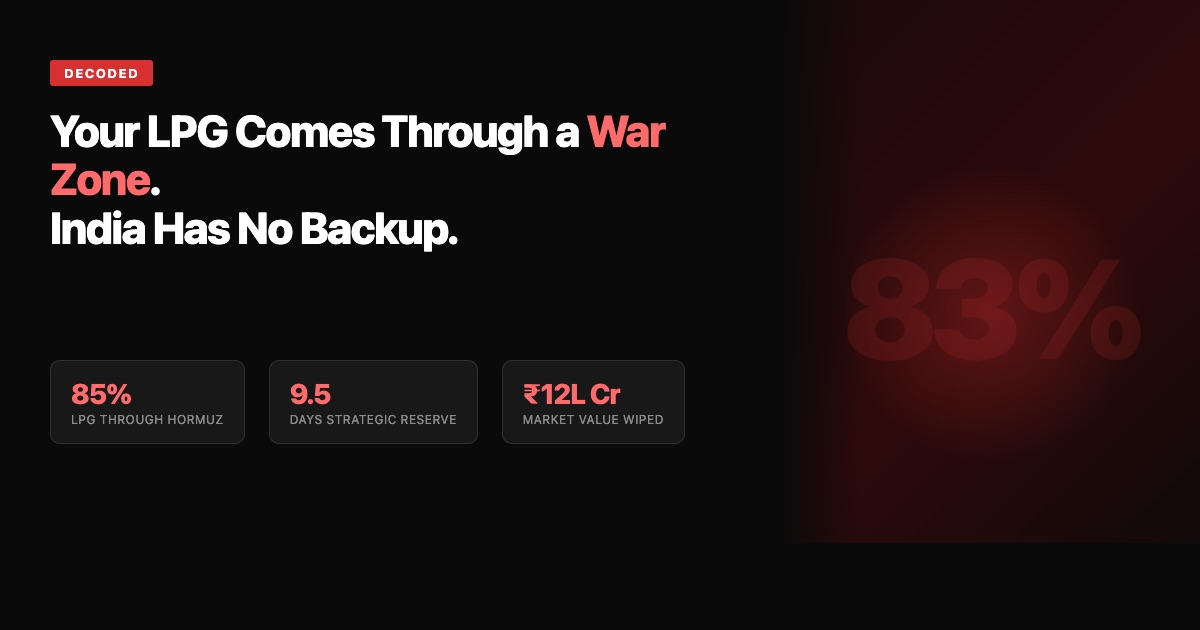
Mar 4, 9:15 AM — Sensex crashes 1,800 points. Rs 12 lakh crore wiped out.
Between your kitchen and your LPG cylinder is a 33-mile-wide strait.
Iran just shut it.
If you cook with gas — and 31 crore Indian families do — this story is about you. Not about geopolitics. Not about market charts. About the cylinder sitting in your kitchen and the single supply line that feeds it.
That supply line is the Strait of Hormuz — a 33-mile-wide chokepoint between Iran and Oman where 20-30% of the world's seaborne oil passes through every day. Iran controls the northern shore. And on March 2, 2026, the Islamic Revolutionary Guard Corps shut it down.
Rs 852.50 Today. Maybe Not Tomorrow.Your domestic LPG cylinder costs Rs 852.50. That price hasn't changed — yet. But it will, because the supply chain that keeps it stable just broke.
Here's why. India imports 1.83 to 2.03 million tonnes of LPG every month. Of that, 1.66 to 1.78 million tonnes — roughly 80-85% — comes from Qatar, Saudi Arabia, UAE, and Kuwait. Every drop of it transits through the Strait of Hormuz.
The Pradhan Mantri Ujjwala Yojana (PMUY) subsidizes Rs 300 per cylinder for 9 refills per year. That subsidy assumes stable global LPG prices. Commercial cylinders — the ones restaurants and businesses use — have already been hiked Rs 28-31 in March. Domestic cylinders are next.
Every $10 per barrel rise in crude oil adds 20-30 basis points to India's inflation. Brent crossed $82 on March 3. If it hits $100 — Goldman Sachs isn't ruling it out — your grocery bill, your auto fare, your cooking gas, all of it gets repriced.
You'll hear a comforting narrative in the next few days: "India has diversified. We buy from Russia now." That's true — for crude oil. It's dangerously false for LPG.
Russia supplies 23% of India's crude, shipped through the Baltic Sea and Black Sea — routes that don't go anywhere near Hormuz. After the 2022 Ukraine war, India pivoted brilliantly to discounted Russian crude. That hedge worked. For oil.
But LPG has no Russian alternative at scale. Russia doesn't export meaningful volumes of LPG to India. The Gulf states — Qatar, Saudi, UAE, Kuwait — are the only suppliers that can meet India's 2 million tonne monthly appetite. And every single tanker from those countries passes through Hormuz.
This is the vulnerability nobody is talking about. Crude oil has alternatives. LPG doesn't. Russia is a cushion for petrol and diesel. For the cylinder in your kitchen, there is no cushion.
Five Days That Changed India's Oil Math| Energy Source | Total Imports | Through Hormuz | Risk Level |
|---|---|---|---|
| Crude Oil | 4.2M barrels/day | ~50% | HIGH |
| LPG | 1.83-2.03 MT/month | 80-85% | CRITICAL |
| LNG | 53% Gulf-linked | ~53% | HIGH |
| What $10 More Per Barrel Costs India | Impact |
|---|---|
| Current Account Deficit | +0.35% of GDP wider |
| Inflation | +20-30 basis points |
| Import Bill | +$12-15 billion/year |
| Rupee | Further depreciation pressure |
The Strait of Hormuz is 33 miles wide at its narrowest point. The actual shipping lane is just 3 miles across — two 2-mile-wide channels separated by a 2-mile buffer zone. Every day, 20-30% of the world's seaborne oil passes through this gap.
Iran controls the entire northern shoreline. Its IRGC naval forces have fast-attack boats, anti-ship missiles, and naval mines positioned along the coast. Even without a full military closure, the threat alone disrupts traffic. Over 150 ships are now anchoring outside the strait, waiting.
Tanker traffic is down 70%. But here's the part that hits India even without a single missile: insurance. War-risk premiums for tankers transiting the Gulf have spiked. Higher insurance means higher freight costs. Higher freight costs get passed to the buyer. The buyer is India — the world's third-largest oil importer.
Even a partial closure — where some tankers sneak through under military escort — raises costs dramatically. This is not a binary switch. It's a spectrum of pain, and India is at the wrong end of it.
74 Days of Stock. Then What?The government's response has been reassuring. Oil Minister Hardeep Singh Puri told Parliament that India is "well-stocked" and has 6-8 weeks of fuel supplies. The Strategic Petroleum Reserve (SPR) has been activated. Contingency plans are in place.
Let's break down those numbers.
What the Government Says
- India has 74 days of total fuel coverage
- SPR: 5.33 million tonnes at 3 locations (Vizag, Mangaluru, Padur)
- Commercial stocks: 64.5 days held by IOC, BPCL, HPCL
- Contingency plans activated; SPR release authorized
- Russian crude supply can compensate for lost Gulf oil
The Reality Check
- SPR = only 9.5 days of India's crude consumption
- 64.5 days of "commercial stock" is inventory, not emergency reserves — it gets used daily
- If crisis extends beyond 2 months, India has zero strategic buffer
- SPR target was 90 days — India is still at 9.5 after years of planning
- LPG has no strategic reserve at all — zero days of backup
The 74-day number sounds comfortable until you understand it. 9.5 days are actual strategic reserves — underground caverns at Vizag (1.33 MT), Mangaluru (1.5 MT), and Padur (2.5 MT). The remaining 64.5 days are commercial stocks — oil that IOC, BPCL, and HPCL keep in their tanks for daily operations. That's not "reserves." That's inventory. You're counting the petrol already in the pipeline as emergency supply.
| Option | Viability | Timeline |
|---|---|---|
| Pivot to Russian crude | Partial — covers oil, NOT LPG | Immediate |
| Release SPR | 9.5 days only | Already planned |
| Alternative Gulf routes | Long and risky — UAE pipelines to Fujairah bypass Hormuz but have limited capacity | Weeks |
| Domestic production ramp-up | India produces only 12-15% of its needs | Months to years |
The analysts are not optimistic. Goldman Sachs flagged Indian companies as "most impacted in Asia" from the oil shock. Societe Generale warned India's "underperformance will deepen." Oil is already up 37% in 2026.
If Brent hits $100 — and sustained Hormuz closure makes that probable, not speculative — here's what India faces:
Import bill swells $25-30 billion per year. India's current account deficit, already at $13.2 billion in Q3 FY26, could breach 2.5% of GDP. The rupee — already at record lows — faces further depreciation pressure, making every imported barrel even more expensive in rupee terms.
Petrol and diesel price hikes become unavoidable. OMCs (Oil Marketing Companies) have been absorbing losses to keep pump prices stable before elections and festivals. At $100 crude, that absorption stops. The math doesn't work.
LPG subsidy bill explodes — or cylinder prices jump Rs 100-200. The government currently subsidizes PMUY cylinders at Rs 300 each for 9 refills per year. If global LPG prices surge 30-40%, the choices are: spend tens of thousands of crores more on subsidies, or let prices rise and hit 31 crore households. (For context, India's broader strategic hedging challenges in the Gulf make this even more complicated.)
This is the most uncomfortable part of the story. India knew this could happen. The government announced a target of 90 days of strategic petroleum reserves. Multiple committees recommended it. The International Energy Agency mandates it for member countries. India aspired to it.
Current status: 9.5 days.
The three existing SPR facilities — Vizag (1.33 MT), Mangaluru (1.5 MT), and Padur (2.5 MT) — hold a total of 5.33 million tonnes. Phase 2, which was supposed to add 6.5 million tonnes at Chandikhol (Odisha) and an expansion at Padur, has been "under construction" or "planned" for years. It still isn't operational.
For comparison:
| Country | Strategic Reserve | Days of Coverage |
|---|---|---|
| United States | 400+ million barrels (SPR) | ~40+ days (SPR alone) |
| China | Estimated 80+ days | 80+ days |
| Japan | IEA compliant | 90+ days (strategic + commercial) |
| India | 5.33 MT | 9.5 days |
India is the world's third-largest oil importer. It consumes over 4.2 million barrels per day. It has 9.5 days of strategic reserves. This isn't a failure of planning. It's a failure of execution that has persisted through multiple governments, multiple oil ministers, and multiple crises.
The Core Failure
India's diversification talk didn't match its action. We pivoted to Russian crude — that was smart. We built SPR caverns — that was good. But we filled them to 9.5 days instead of 90. We built no LPG strategic reserves at all. And we remained 80-85% dependent on Gulf LPG with zero alternative routing. The Hormuz crisis didn't create India's vulnerability. It just revealed it.
India imports 88% of its crude oil. Domestic production — from ONGC, Oil India, and private operators — has been flat for years, stuck at 12-15% of demand. Every promise of increasing domestic production has been made. None has been delivered at scale.
Renewable energy is growing — India installed 18 GW of solar in FY25 alone. But solar panels don't cook your food. Wind turbines don't power your car. The transition from fossil fuels is measured in decades, not quarters. In the short term, India runs on imported oil and gas, and it will for at least 15-20 more years.
The Strait of Hormuz crisis exposes a structural vulnerability, not a temporary disruption. This chokepoint has been a known risk since the 1980s Iran-Iraq "Tanker War." It nearly closed during the 2019 Iran-US tensions. The question was never if but when.
When it happened, India had 9.5 days of strategic reserves, zero LPG alternatives, and 31 crore families cooking with gas that comes through a war zone.
This will happen again. The geopolitics of the Gulf guarantee it. The question is whether India will be more prepared next time — or whether we'll be reading the same "India is well-stocked" reassurances from a different oil minister, while the same structural gaps remain unfixed.
The Bottom Line
India has 74 days of fuel stock. That's the good news. The bad news: only 9.5 of those are strategic reserves. The worse news: 80-85% of your LPG has no alternative route. Russia can cushion crude oil — but the gas cylinder in your kitchen has exactly one supply line, and it runs through a war zone. Commercial LPG prices have already been hiked. If Brent crosses $100, domestic cylinders follow. India's import bill swells $25-30 billion. Inflation rises a full percentage point. And the Sensex crash of March 4 — Rs 12 lakh crore gone — is just the market pricing in what your kitchen will feel in weeks. This isn't a temporary crisis. It's a structural vulnerability that India has known about for years and hasn't fixed. The 90-day SPR target is still 9.5 days. The LPG strategic reserve doesn't exist. 88% import dependency isn't a strategy. It's a bet — and Hormuz just called it.