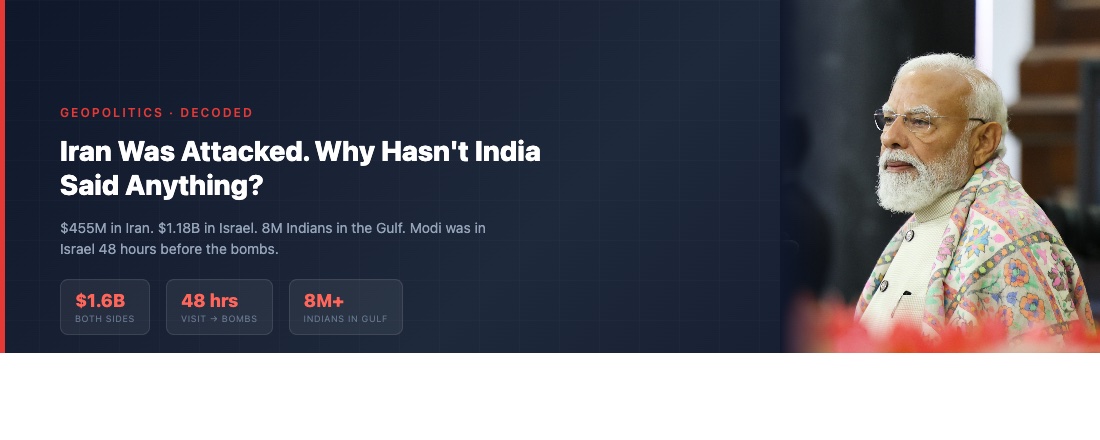
February 28, 2026: US and Israeli forces strike Iran. Ayatollah Khamenei is killed.
48 hours between the visit and the bombs.
India's response? Nothing. No statement. No condemnation. No "both sides should show restraint." Just silence.
When bombs fall on a country where you've invested half a billion dollars, silence is unusual. When you were photographed shaking hands with the other side 48 hours earlier, silence is a strategy.
India has $1.6 billion locked into ports on both sides of this conflict. Over 8 million Indian citizens live and work in the Gulf region, sending home $32 billion+ in remittances every year. And the country is in the middle of negotiating a trade deal with the United States — the same country that just launched the strikes.
So why hasn't India said anything? Because saying anything costs money. And India has too much on the table.
8 Million Indians. $32 Billion in Remittances. That's the Real Story.Before this becomes a debate about ports and geopolitics, consider the human math. Over 8 million Indians work in Gulf countries — UAE, Saudi Arabia, Qatar, Oman, Kuwait, Bahrain. For a construction worker in Dubai or a nurse in Riyadh, any escalation in the region means potential job losses, flight disruptions, and families back home missing rent money.
Their remittances — over $32 billion annually — are the single largest source of foreign income for states like Kerala, Bihar, and Uttar Pradesh. A regional war doesn't just disrupt oil supplies. It disrupts lives.
A prime minister's first duty isn't to issue press statements. It's to make sure those 8 million people stay safe, employed, and undisrupted. By that measure, silence that prevents escalation is more useful than a statement that provokes one.
$455 Million in Iran. $1.18 Billion in Israel. One Country.India didn't stumble into this dilemma. It was built deliberately over two decades.
Chabahar Port, Iran: India has invested $455 million in developing this port on Iran's southeastern coast. It's operated by India Ports Global Ltd — a government entity. No private player. No Adani. No Ambani. Pure strategic investment. The port is India's only route to Afghanistan and Central Asia that doesn't go through Pakistan.
Haifa Port, Israel: Adani Ports acquired a 70% stake for $1.18 billion in 2022 — paying a 55% premium over the next highest bidder. It's a private deal, not a government investment. Adani holds a 66-year concession to operate Israel's busiest port.
| Metric | Chabahar (Iran) | Haifa (Israel) |
|---|---|---|
| Investment | $455M (Government) | $1.18B (Adani, 70%) |
| Cargo growth | 1.2M → 2.84M tonnes (FY21-24) | +28% containers (Q1 FY25) |
| Revenue | Barely breaks even | Record EBITDA (undisclosed) |
| Who profits? | India (strategic access) | Adani shareholders |
| Concession | 10 years (govt-to-govt) | 66 years (private) |
| Humanitarian use | 2.5M tonnes wheat to Afghanistan | None |
| Pakistan bypass | Yes — only route | Not applicable |
| Trade corridor | INSTC (India-Russia-Europe) | IMEC (India-Middle East-Europe) |
This is the question critics raise. The Adani Group bought Haifa at a 55% premium — more than any other bidder was willing to pay. Critics argue no rational private buyer overpays that much without assurances from the top. Adani's overseas port empire now spans Israel, Sri Lanka, Tanzania, and Vietnam — over $2.1 billion in total. (For context on how India's investment pledges translate into reality, the gap between announcement and execution is a recurring theme.)
The counter-argument is also data-backed. Haifa's container volumes are up 28%. Bulk cargo surged 45%. The port posted record quarterly revenue. It's making money — for Adani's shareholders, yes, but also feeding into India's IMEC corridor ambitions (India-Middle East-Europe), which is India's answer to China's Belt and Road.
The "Protecting India" Argument
- 8M Indians in Gulf are safe — no evacuations needed
- Chabahar stays operational — sanctions waiver extended to April 2026
- $8.6B defense supply chain with Israel uninterrupted
- US trade deal negotiations undisturbed
- Oil imports already diversified away from Iran
The "Protecting Adani" Argument
- $1.18B Haifa port = Adani's largest overseas asset
- 55% purchase premium suggests state backing
- Profits go to APSEZ shareholders, not Indian treasury
- US indictment of Adani (2025) raised cronyism questions
- India has no government equity or override at Haifa
The uncomfortable truth is that both arguments have merit. Modi built a foreign policy where national interest and private capital are deliberately intertwined. You can call it strategic or you can call it cronyism. But you can't separate them anymore. And that may be by design.
Why Silence Is the Only Free MovePrevious prime ministers could afford moral clarity on the Middle East. Vajpayee condemned Israel's 2002 Jenin operation openly — India had no defense dependency. Manmohan Singh called for "restraint from all sides" on Iran — India hadn't yet signed the Chabahar deal. The moral math was cheap.
Modi's math is different. Every word has a price tag:
| If India says... | It risks... | Cost |
|---|---|---|
| Condemn the strikes | US trade deal, $8.6B defense imports, IMEC corridor | Billions |
| Support the strikes | Chabahar access, INSTC corridor, Iran oil option | $455M + strategic depth |
| "Both sides restraint" | Nothing immediately — but satisfies no one | Credibility |
| Stay silent | Nothing today — but Iran notices | Future goodwill |
The economic calculus brutally favours silence. India-Iran trade has already collapsed from $17 billion to under $2 billion in a decade — mostly due to US sanctions. Condemning the strikes risks everything India has with the US and Israel — including the concessions India made in its tariff negotiations — for a relationship that's already been hollowed out.
But Silence Has an Expiry DateHere's what the silence costs — just not today.
Chabahar's 10-year concession will come up for renewal. The 750 km Chabahar-Zahedan railway — India's link to the INSTC corridor — is being built on Iranian soil. Iran controls whether India's only Pakistan-bypass route stays open.
Iran notices who spoke and who didn't. China, which signed a $400 billion deal with Iran, didn't stay silent. Russia didn't stay silent. India — which claims leadership of the Global South and demands a permanent UN Security Council seat — did.
Every country India asks to support its UNSC bid will remember this silence. Strategic autonomy — India's brand since Nehru — looks less autonomous when the silence aligns perfectly with Washington's preference.
The Core Tension
Modi built India's most ambitious hedging strategy in the Middle East — ports on both sides, defense with one, energy with the other, trade corridors through both. It was brilliant until both sides went to war. Now the hedge is a trap. Speaking up costs one relationship. Staying silent costs credibility with both.
The Bottom Line
India's silence on the Iran strikes isn't weakness — it's arithmetic. $1.6 billion in ports, $8.6 billion in defense deals, 8 million citizens, and a US trade deal on the table. Every word costs something. But silence isn't free either. Iran controls India's only route to Central Asia. The cheapest move today could become the most expensive one when Chabahar's lease comes up for renewal. Modi isn't being silent because he has nothing to say. He's being silent because he has too much to lose.