December 2025. India announces satellite and AI-based tolling, complete by year-end 2026.
April 2025. India announces physical toll plazas will "soon be removed." Four days later, a government clarification denies it.
March 2021. India announces all toll booths will be removed within one year using GPS technology.
It has been 5 years. The tech name has changed 6 times. One pilot plaza is operational. 1,087 are waiting.
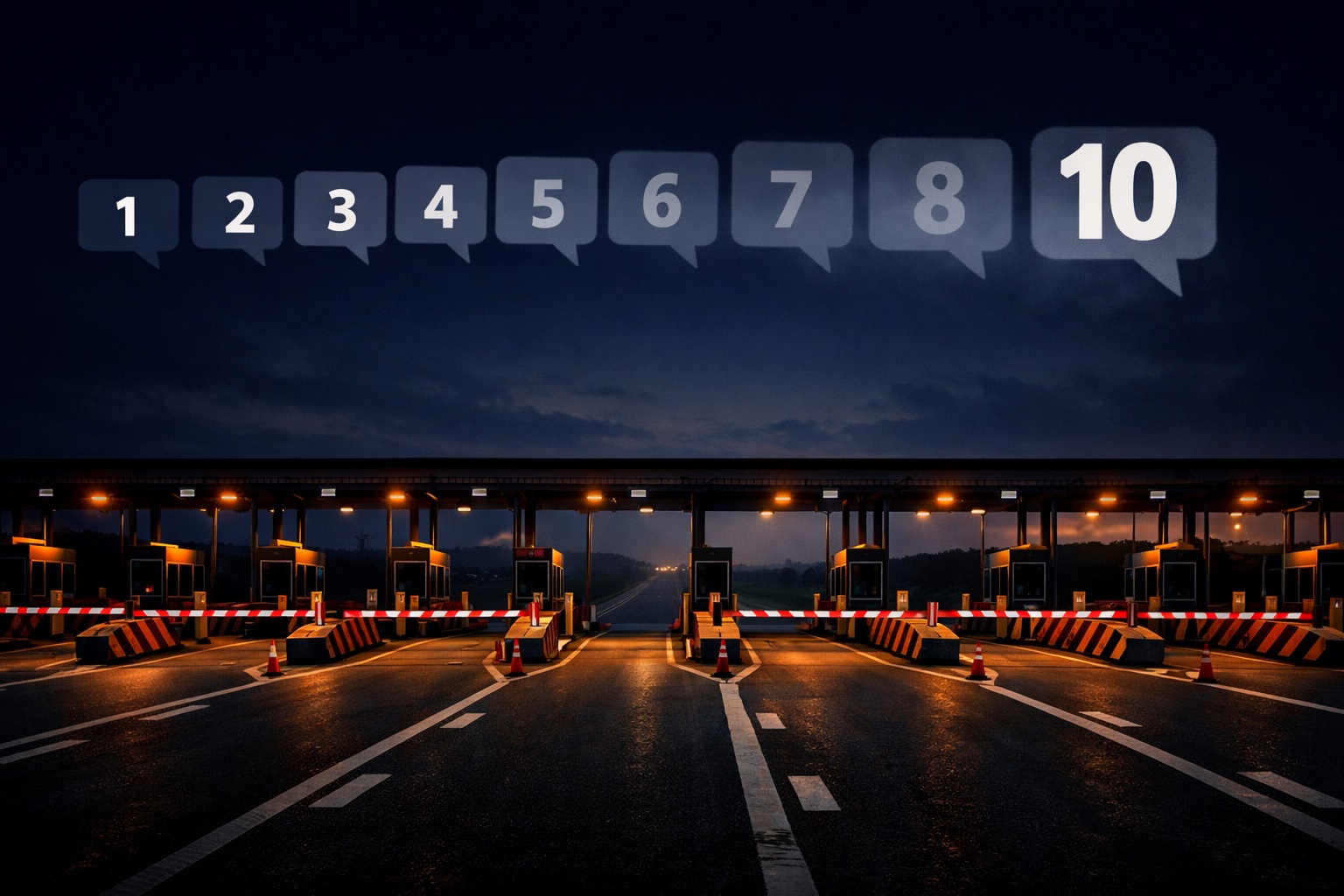
Since 2019, India's Transport Ministry has announced the end of traditional toll plazas at least 10 times. Each announcement introduced a new technology name. Each set a deadline. None were met. Here is the complete record.
| # | When | What Was Promised | Deadline | What Happened |
|---|---|---|---|---|
| No. 1 | 2019 | HSRP-based removal of toll plazas | Vague | HSRP itself still at 19% compliance |
| No. 2 | Feb 2021 | "All toll booths removed in 1 year, GPS-based" | Feb 2022 | Missed completely |
| No. 3 | Mar 2022 | "Toll plazas within 60 km shut in 3 months" | Jun 2022 | Missed completely |
| No. 4 | Sep 2022 | ANPR cameras to replace toll plazas | Not specified | Pilot only in 2025 |
| No. 5 | Dec 2023 | "GPS-based toll by March 2024" | Mar 2024 | Missed completely |
| No. 6 | Feb 2024 | "New system to replace FASTag in 6 months" | Aug 2024 | Missed completely |
| No. 7 | Mar 2024 | "Satellite-based system to replace tolling" | Not specified | Nothing happened |
| No. 8 | Apr 2025 | "Physical toll plazas will soon be removed" | "Soon" | PIB denied it 4 days later |
| No. 9 | Dec 2025 | "AI + satellite, zero wait time, done by 2026 end" | Dec 2026 | Current promise — pending |
| No. 10 | Apr 2026 | AI-powered detection, auto-deduct, no stopping | Not specified | You are reading about it right now |
Notice the pattern. The technology name changes — GPS, satellite, GNSS, ANPR, AI, MLFF — but the promise stays the same: vehicles will pass through toll points without stopping, and money will be deducted automatically. Each new announcement resets the clock. The old deadline is never acknowledged.
This is not about questioning intent. The direction is right. Every developed country is moving toward barrier-free tolling. The question is: why does India keep announcing nationwide rollouts when the groundwork for even a small-scale deployment hasn't been completed?
FASTag Worked. That's Worth Acknowledging.Before examining what hasn't worked, it's important to recognize what has. FASTag — India's RFID-based electronic toll collection system — is a genuine infrastructure success.
Piloted in November 2014, made mandatory (after four deadline extensions) in February 2021, FASTag now processes over 98% of toll transactions on national highways. As of February 2026, Transport Minister Nitin Gadkari confirmed 11.86 crore FASTags have been issued, with 5.9 crore active. Cash lanes were fully eliminated on April 1, 2026 — all payments are now via FASTag or UPI.
But FASTag solved the payment problem, not the stopping problem. Vehicles still slow down, approach a barrier, wait for the tag to read, watch the barrier lift, then accelerate. The 10-second passing rule exists on paper. In practice, commuters at Kherki Daula (handling 1.5–2 lakh vehicles daily) or Mumbai's entry toll points (3.6 lakh vehicles daily) still report 20–30 minute waits during peak hours.
India is not trying to invent something new. Barrier-free toll collection is proven technology, operational across multiple countries — some for over 30 years.
| Country | System | Since | Approach |
|---|---|---|---|
| Portugal | Via Verde | 1991 | One of the world's first nationwide ETC systems |
| Singapore | ERP | 1998 | Phased by corridor. ERP 2.0 GNSS still rolling out (delayed from 2020) |
| Switzerland | LSVA | 2001 | First GPS-assisted distance tolling. Trucks only. |
| Germany | Toll Collect | 2005 | GPS truck tolling. 17 months late, became a scandal. Expanded over 19 years. |
| USA | Open Road Tolling | ~2005 | Illinois first. Vehicles pass at highway speed. PA Turnpike took 10 years. |
| Ireland | M50 eFlow | 2008 | Replaced barrier toll overnight. 30-min delays eliminated. ONE corridor only. |
Two patterns emerge from every successful deployment worldwide.
First, every single one was phased. Ireland started with just the M50 motorway — its other toll roads still use traditional barriers. The Pennsylvania Turnpike spent a full decade going from feasibility study (2010) to pilot (2016) to cashless (2020) to barrier-free (January 2025) — and still isn't done on the western sections. Singapore rolled out ERP corridor by corridor: East Coast Parkway first in April 1998, then Central Expressway, then the CBD. Germany started with trucks over 12 tonnes on the Autobahn in 2005, extended to federal roads in 2018, and only included trucks over 3.5 tonnes in July 2024 — a 19-year phased expansion.
Second, no country has implemented GPS/GNSS distance-based tolling for all vehicles including private cars. Every successful GNSS system — Switzerland, Germany, Czech Republic, Poland, Hungary — applies only to heavy commercial vehicles (trucks above 3.5 tonnes). India has been promising GNSS-based tolling for all vehicles since 2021 — something no country in the world has accomplished.
Why This Matters
India is not behind because the technology doesn't exist. India is behind because other countries took 5–20 years of phased, corridor-by-corridor implementation — while India keeps announcing nationwide rollouts with 12–18 month deadlines.
As of April 2026, India has exactly one operational MLFF (Multi-Lane Free Flow) toll plaza — at Choryasi Fee Plaza in Gujarat on NH-48. NHAI plans to add roughly 25 more this financial year. There are approximately 1,087 toll plazas on national highways.
At the current pace, full rollout would take decades, not months. But the pace isn't even the biggest challenge. There are structural obstacles that no amount of announcements can bypass.
The HSRP Problem: ANPR Needs Plates It Can ReadANPR (Automatic Number Plate Recognition) is the backbone of barrier-free tolling. Cameras photograph the number plate, read it, match it to a FASTag or bank account, and deduct the toll. For this to work, number plates must be standardized.
India mandated High Security Registration Plates (HSRP) in 2001. Twenty-five years later, compliance is catastrophically low. Maharashtra — one of the best-documented states — shows only 19.4% of pre-2019 vehicles have HSRP fitted. In Nashik, it's 25%. In Thane, 24%.
Pre-2019 vehicles constitute the majority of India's 40+ crore registered fleet. Without standardized plates, ANPR cameras struggle. Industry estimates suggest accuracy in Indian conditions rarely exceeds 70%. Trucks, which form a large portion of toll-paying traffic, often have plates that are dirty, damaged, or decorated with extra text — names of deities, "Government of India," children's names. Cameras can't parse these.
GPS/GNSS-based tolling — where a device in every vehicle tracks distance traveled and charges accordingly — was the original vision. It was officially shelved in April 2025. The government denied satellite-based tolling would launch and pivoted to ANPR-FASTag hybrid instead.
The reason, beyond technical challenges, was privacy. A GPS chip in every vehicle would create one of the most extensive surveillance systems in the country. India's Digital Personal Data Protection Act 2023 allows the government to exempt itself from safeguards — meaning there were no guarantees the data would be used only for tolling.
Infrastructure Is Not Evenly DistributedIndia is a large country where digital infrastructure varies enormously. MLFF tolling requires high-speed cameras, reliable internet for real-time processing, uninterrupted power, and backend systems that can handle millions of transactions. Many rural toll plazas on secondary national highways don't have the connectivity or power reliability for real-time ANPR processing. A one-size-fits-all rollout ignores this reality.
The Enforcement GapIn a barrier-free system, if a vehicle doesn't have FASTag and the camera can't read the plate, the vehicle passes through without paying. New National Highways Fee Rules 2026 attempt to address this with e-notices, 72-hour grace periods, and double penalties after 15 days. But enforcement depends on ANPR actually working — which circles back to the plate standardization problem.
A Realistic Roadmap. Start With 50 Plazas, Not 1,087.Every country that successfully deployed barrier-free tolling started small, proved the technology, fixed problems, and then expanded. India should do the same. Here's what a phased approach could look like.
Phase 1: The 50 Worst Bottlenecks (Year 1)India's toll plazas are not equally congested. Start with the ones that cause the most misery.
| Toll Plaza | Location | Daily Traffic | Problem |
|---|---|---|---|
| Mumbai entry points (5 plazas) | Mulund, Dahisar, Vashi, Airoli, LBS Marg | ~3.6 lakh | 25-30 min evening queues |
| Kherki Daula | Gurgaon, NH-48 | ~1.5-2 lakh | Chronic traffic jams, relocation pending |
| Hoskote | Bangalore outskirts | ~45,000 | "City's most notorious choke point" |
| Bharthana | Gujarat, NH-48 | High (₹2,043 cr revenue in 5 yrs) | Highest revenue plaza in India |
| Shahjahanpur | Rajasthan, NH-48 | High (₹1,884 cr revenue in 5 yrs) | 2nd highest revenue plaza |
Converting even 50 of the worst bottleneck plazas to MLFF would impact millions of daily commuters and demonstrate whether the technology works at Indian scale and speed.
Phase 2: Fix HSRP First (Year 1-2, Parallel)No amount of ANPR cameras can compensate for non-standardized number plates. A time-bound HSRP enforcement campaign — perhaps linked to FASTag renewal or vehicle insurance — is a prerequisite, not an afterthought.
Phase 3: Learn From Choryasi, Then Scale (Year 2-3)The Choryasi pilot in Gujarat should be studied intensively. What's the read accuracy? What percentage of vehicles pass without payment? What are the failure modes? These answers should determine the expansion timeline — not political announcements.
Phase 4: Highway Corridors, Not Individual Plazas (Year 3-5)Once the technology is proven, expand corridor by corridor — the way Ireland did with the M50, the way Singapore did with the ECP and CTE. The Delhi-Jaipur NH-48 corridor. The Mumbai-Pune Expressway. The Bangalore-Mysuru Highway. Not 1,087 plazas at once.
The Vision Is Right
- FASTag was a genuine success — 98% adoption proves India can execute at scale
- MLFF pilot at Choryasi is a real start, not just an announcement
- Cash lanes eliminated April 1, 2026 — shows follow-through on digital payments
- NHAI now following phased approach: Gujarat, Tamil Nadu, Karnataka, Haryana
- Transport Minister's ambition for barrier-free highways is the right goal
The Execution Gap
- 10 announcements with specific deadlines, none met — credibility erodes
- Technology name changes every announcement: GPS, satellite, GNSS, ANPR, AI, MLFF
- HSRP mandated in 2001, still under 20% compliance — ANPR can't work without it
- One pilot vs 1,087 plazas — current pace would take decades
- 12.55 lakh wrong FASTag deductions in 2024 — trust deficit exists
The latest promise — No. 9 from December 2025 — sets the deadline as "end of 2026" for satellite and AI-based tolling to be complete. The Transport Minister stated in Rajya Sabha that vehicles would pass at 80 km/hr with cameras capturing number plates and satellite photos, with tolls automatically deducted.
Based on the current trajectory: NHAI's own plan targets roughly 25 MLFF plazas in FY 2025-26, with agreements signed for Gujarat (24 more plazas in 3 bundles), Tamil Nadu (Nemili, Chennasamudram), and Karnataka (Bengaluru-Mysuru pilot expected by June 2026). This is meaningful progress — but it's 25-50 plazas, not 1,087.
The gap between announcement and probable delivery by December 2026 is significant. But for the first time, there is a pilot running, agreements signed, and a phased rollout plan that names specific locations. That's more than any of the previous 9 announcements produced.
The Bottom Line
India's goal of barrier-free, non-stop toll collection is the right ambition. The technology exists. Countries with a fraction of India's traffic have been doing it for decades. But credibility comes from delivery, not from announcements — and 10 announcements with 0 barriers removed is a pattern that undermines public trust. The path forward is clear: start with the 50 most congested plazas, fix HSRP compliance so cameras can actually read plates, learn from the Choryasi pilot, and expand corridor by corridor. India doesn't need Announcement No. 11. It needs 50 working plazas.