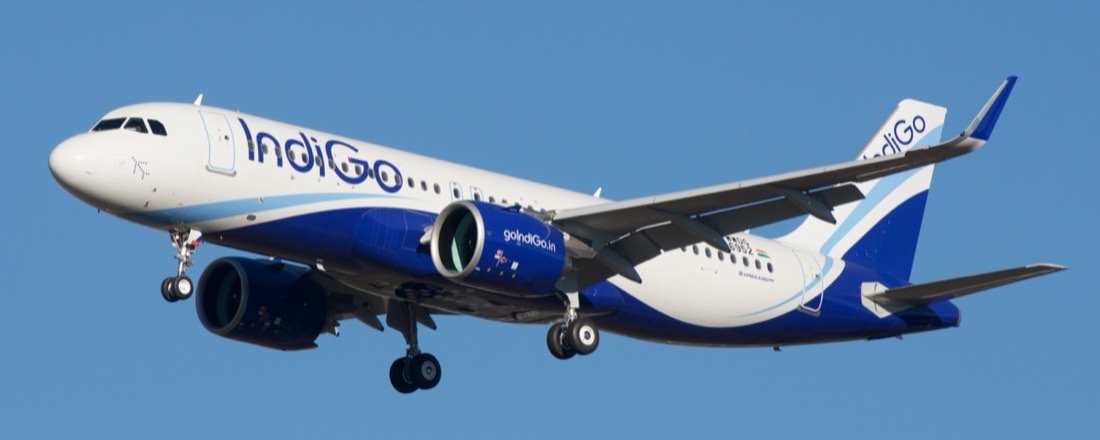
This wasn't a storm. It wasn't a terror threat. It wasn't even an engine failure. India's largest airline — the one that carries 65% of all domestic passengers — collapsed under the weight of its own decisions. And because India's aviation market is effectively a duopoly, there was nowhere else for half a million people to go.
Three months later, the CEO resigned. The regulator imposed the largest fine in Indian aviation history. And the government briefly brought back COVID-era fare caps. But the crisis exposed something deeper than one airline's mismanagement. It exposed an entire ecosystem built without a backup plan.
92% of Your Flights. Two Airlines. One Regulator.India's domestic aviation isn't a market — it's a dependency. IndiGo controls 65% of domestic capacity. The Air India Group (including Air India Express and the absorbed Vistara) holds another 27%. Together, that's 92% of every seat on every domestic flight.
SpiceJet, the third-largest name, posted a ₹261 crore loss in Q3 FY26 and is financially fragile. Akasa Air is growing but still tiny. There is no meaningful alternative when the dominant carrier fails.
This isn't hypothetical anymore. When IndiGo cancelled 4,500 flights in December, the Delhi High Court asked the government a simple question: "Why did you let this happen?"
| Airline | Market Share | Fleet Size | Status |
|---|---|---|---|
| IndiGo | ~65% | 440+ | 10% flight cut ordered until March 28 |
| Air India Group | ~27% | 300+ | Integration ongoing (Air India + Vistara merger) |
| SpiceJet | ~4% | ~30 | ₹261 Cr loss (Q3 FY26), financially fragile |
| Akasa Air | ~3% | ~28 | Growing but too small for backup capacity |
The December meltdown is often described as a sudden crisis. It wasn't. It was a slow-motion failure visible to anyone paying attention.
In November 2024, the DGCA introduced updated Flight Duty Time Limitation (FDTL) rules — the regulations that determine how long pilots can fly, how much rest they need, and how many night landings they can perform. The changes were significant: weekly rest increased from 36 to 48 hours, and night landings were cut from six per week to just two.
Every other Indian airline — Air India, Akasa, SpiceJet — complied on time.
IndiGo didn't. And here's the part that makes the crisis look deliberate rather than accidental: IndiGo halted pilot recruitment in February 2025 — nine months before the rules took full effect — despite needing an estimated 20% more crew to comply.
40+ aircraft grounded simultaneously due to Pratt & Whitney engine defects, leaving IndiGo with only 344 serviceable jets out of a fleet of 440+. The airline was flying a reduced fleet with a reduced crew — and adding more flights anyway.
| Date | Event | Impact |
|---|---|---|
| Nov 2024 | DGCA issues revised FDTL rules | All airlines given 12 months to comply |
| Feb 2025 | IndiGo freezes pilot hiring | Needed 20% more crew; hired none |
| Nov 1, 2025 | FDTL rules take effect | All airlines comply — except IndiGo |
| Nov 2025 | 1,232 IndiGo flights cancelled | 755 due to crew shortages |
| Dec 3-5, 2025 | System collapse: 2,500+ flights cancelled | 580,000 passengers stranded |
| Dec 5, 2025 | On-time performance hits 3.7% | Down from 80% in October |
| Dec 6, 2025 | Government imposes emergency fare caps | ₹7,500–₹18,000 by distance |
| Dec 2025 | DGCA grants IndiGo 3-month FDTL exemption | Night landings relaxed from 2 to 6 |
| Jan 17, 2026 | DGCA imposes ₹22.20 Cr fine | Largest penalty in Indian aviation |
| Feb 11, 2026 | IndiGo's FDTL exemption expires | Full compliance begins |
| Mar 10, 2026 | CEO Pieter Elbers resigns | Rahul Bhatia takes interim charge |
The DGCA's ₹22.20 crore fine — the largest in Indian aviation history — breaks down to ₹1.80 crore as a one-time systemic penalty plus ₹30 lakh per day for 68 days of violations. For an airline with over ₹24,500 crore in quarterly revenue, the fine amounts to less than 0.1%.
The Federation of Indian Pilots called it "light." And they're right — the numbers tell the story:
The broader damage is staggering. India's aviation industry is expected to report net losses of ₹17,000–18,000 crore in FY2026, driven by fuel costs, Middle East airspace closures, and the ripple effects of the IndiGo crisis. The DGCA also required IndiGo to furnish a ₹50 crore bank guarantee under a structured reform programme — the "IndiGo Systemic Reform Assurance Scheme" — with phased release tied to compliance milestones over 15 months.
| DGCA Fine Breakdown | Amount |
|---|---|
| One-time systemic penalty (multiple CAR violations) | ₹1.80 Cr |
| Daily penalty: ₹30 lakh/day x 68 days (Dec 5 – Feb 10) | ₹20.40 Cr |
| Total fine | ₹22.20 Cr |
| Bank guarantee (reform compliance) | ₹50 Cr |
| Show-cause notices to IndiGo (highest of any airline) | 98 |
India has two mechanisms for controlling airfares. Neither worked when it mattered.
The UDAN Promise: Flying for ₹2,500Launched in 2016, the UDAN (Ude Desh ka Aam Nagrik) scheme promised affordable regional air travel — ₹2,500 per hour of flight, with 50% of seats reserved at this subsidized fare. The tagline: every Indian should be able to fly.
The reality: of 649 UDAN routes awarded since inception, 225 have failed. 128 routes shut down before completing the mandatory three-year support period. 70 were deemed commercially unviable despite government subsidies. 16 airports built under UDAN sit completely unused, and the government has spent nearly ₹900 crore on 15 regional airports that remain non-operational.
Budget 2026 allocated ₹550 crore to UDAN subsidies, and a ₹30,000 crore revamp has been proposed. But the scheme's track record — airports inaugurated with fanfare only to suspend operations months later due to lack of passengers — raises the question: does India have a capacity problem, or a planning problem?
The COVID Fare Bands: Dormant Until DisasterWhen the pandemic grounded flights in 2020, the DGCA introduced seven fare bands based on flight duration — from ₹2,000–₹6,000 for flights under 40 minutes to ₹6,500–₹18,600 for flights over 3 hours. These were lifted in 2022 when markets normalized.
But they were never formally withdrawn. They lay dormant — until December 2025, when the government reactivated them with updated distance-based caps: ₹7,500 for routes under 500 km, ₹12,000 for 500–1,000 km, ₹15,000 for 1,000–1,500 km, and ₹18,000 beyond. The DGCA began scraping real-time fares daily with the threat of route suspensions for offenders.
The caps worked — temporarily. But they treat the symptom (price gouging during supply shocks) and not the disease (a market so concentrated that one airline's failure sends fares through the roof).
| Fare Control Mechanism | Cap | Status (March 2026) |
|---|---|---|
| UDAN scheme (regional routes, 50% seats) | ₹2,500/hour | Active — but 225 of 649 routes have failed |
| COVID fare bands (7 tiers by duration) | ₹2,000–₹18,600 | Dormant (lifted 2022, not withdrawn) |
| Emergency caps (Dec 2025, distance-based) | ₹7,500–₹18,000 | Temporary — until "fares stabilize" |
| Delhi-Mumbai actual fare (Dec 5, 2025) | — | ₹65,460 (before caps took effect) |
This is the part of the story that should make everyone uncomfortable. The DGCA's response to the IndiGo crisis was simultaneously aggressive and contradictory.
On one hand: A record ₹22.20 crore fine. A ₹50 crore bank guarantee. 98 show-cause notices. A 10% flight cut until March 28, 2026. Personal warnings to the CEO and senior executives.
On the other hand: The DGCA granted IndiGo a three-month exemption from the very FDTL rules it had failed to follow. Night landings were relaxed from two back to six per week. The regulator allowed IndiGo to redefine "night" from midnight–6 AM to midnight–5 AM — effectively weakening the safety standard.
Captain Anil Rao of the Airline Pilots Association of India asked what everyone was thinking: "If something goes wrong during a flight, will the regulator give an exemption to the pilot?"
A pilot who left IndiGo after the crisis described an incident where fatigue after three consecutive night shifts caused him to instinctively turn the aircraft left instead of right during taxiing — a near-miss averted only by co-pilot intervention. His assessment: rest protocols are "survival rules, not workplace perks."
DGCA's Defence
- Without exemption, IndiGo would have cancelled thousands more flights — worsening passenger impact
- The fine is the largest ever imposed on an Indian airline
- 352 show-cause notices issued across all airlines — signalling an industry-wide crackdown
- ₹50 Cr bank guarantee ensures IndiGo follows through on reforms
Critics' Response
- ₹22.2 Cr fine = less than 0.1% of quarterly revenue — not a deterrent
- Exemptions undermine regulatory credibility; pilots call rest rules "survival rules"
- 4 DGCA inspectors were terminated after the crisis — but who approved the exemptions?
- India's 48-hr rest exceeds US/UK (30–36 hrs) but lacks Europe's night curfews — pilots still flying exhausted schedules
IndiGo is operating under a DGCA-mandated 10% flight cut until March 28, 2026. What happens after that depends on whether the airline can demonstrate sustained compliance under the Systemic Reform Assurance Scheme. The ₹50 crore bank guarantee is being released in phases: ₹10 crore for leadership reforms (3-month target), ₹15 crore for manpower and fatigue-risk management (6-month sustained compliance).
Meanwhile, IndiGo has no permanent CEO. Pieter Elbers resigned March 10, effective immediately. Co-founder Rahul Bhatia — who holds a 35.69% stake through InterGlobe Enterprises — took interim charge. The board waived Elbers' notice period, suggesting the exit was not entirely "personal."
To address the duopoly risk, the government cleared three new domestic airlines in December 2025: Shankh Air (Noida), Alhindair (Kerala, ATR turboprops), and FlyExpress (Telangana, low-cost). All received No Objection Certificates. None has acquired aircraft, completed safety audits, or secured an Air Operating Certificate. They are years from commercial service — if they survive at all. India's aviation graveyard is full of airlines that got NOCs and never flew.
Plot Twist: The Stock Rose 3% When the CEO Quit.When Pieter Elbers' resignation was announced on March 10, most analysts expected the stock to fall. Leadership vacuums during operational crises typically punish share prices.
IndiGo's stock rose 3%, touching ₹4,512.90 on the NSE.
The market's message was clear: the problem was the management, not the airline. Elbers, the former KLM CEO who joined in September 2022, had led IndiGo past the $10 billion revenue milestone and secured a record 500-aircraft Airbus order. But he also presided over the hiring freeze, the FDTL non-compliance, and the worst operational crisis in the airline's history. Investors saw his exit as accountability — and priced it as a positive.
This raises an uncomfortable question for India's broader market. If investors punish incompetence only after a crisis severe enough to strand 580,000 passengers, what incentive do airline executives have to invest in safety and compliance before things break?
580,000 Passengers. ₹10,000 Vouchers. One Class Action.The passengers who bore the cost of IndiGo's failure are still waiting for resolution. Under DGCA rules, passengers delayed more than three hours are entitled to a ₹10,000 compensation voucher valid for 12 months. IndiGo told the Delhi High Court that refunds for cancelled tickets had been processed, but compensation to stranded passengers was still underway. Estimated total compensation liability: over ₹500 crore.
More significantly, a LocalCircles survey of over 30,000 IndiGo passengers found that 87% support a class action lawsuit under the Consumer Protection Act, 2019. If filed, it would be one of the largest consumer actions against an Indian airline. Consumer courts have awarded ₹25,000–₹1,00,000 in individual service deficiency cases — a class action aggregating hundreds of thousands of claims could dwarf the DGCA's fine.
India Wants 5 Airlines. It Can Barely Sustain 2.India's aviation ambition is enormous. Passenger traffic is projected to grow from 412 million in FY25 to 580 million by FY30. Over ₹1 lakh crore ($12 billion) is being invested in new airports at Jewar, Navi Mumbai, Bhogapuram, and Purandar. The Aviation Minister has called for "more airlines" to ensure healthy competition.
But the structural reality is sobering:
| Challenge | The Number | What It Means |
|---|---|---|
| Pilot shortage | 24,000–30,000 needed | 1,700 aircraft on order, not enough crew to fly them |
| UDAN route failures | 225 of 649 routes | 35% of "affordable flying" routes have collapsed |
| Unused airports | 16 built, none operational | ₹900 Cr spent on airports with no flights |
| Industry losses (FY26) | ₹17,000–18,000 Cr | Fuel costs + Middle East disruption + IndiGo crisis |
| New airline readiness | 3 NOCs granted | Years from first flight — if they survive |
| Pilot retention barriers | 6-month notice + NOC | ICAO calls this "excessive" — pilots can't easily switch |
India needs more airlines. But building an airline requires pilots India doesn't have, on routes that have repeatedly failed, at airports passengers don't use, in a market where the dominant player is "too big to regulate" and the regulator can't decide whether to punish or protect it.
The Bottom Line
India's aviation crisis isn't about one airline's bad quarter. It's about a market structure where 65% concentration in a single carrier creates systemic risk for 412 million passengers. The DGCA fined IndiGo — then exempted it from the rules it broke. The government promised ₹2,500 flights — then watched 225 UDAN routes fail. India wants five airlines — but can barely keep two solvent. The December collapse was a preview, not an anomaly. Until the duopoly is broken, the pilot shortage is addressed, and the regulator decides whether it's an enforcer or an enabler, India's aviation is one bad decision away from the next crisis. The only question is whose flights get cancelled next.
IndiGo failed to comply with updated FDTL rules that increased pilot rest from 36 to 48 hours weekly and cut night landings from 6 to 2 per week. Every other Indian airline complied on time. IndiGo had also frozen pilot hiring in February 2025 despite needing 20% more crew, and had 40+ aircraft grounded due to Pratt & Whitney engine issues.
What is the DGCA fare cap on domestic flights in India?India has two fare control mechanisms: (1) COVID-era DGCA fare bands from 2020 with 7 tiers from ₹2,000–₹6,000 for flights under 40 minutes to ₹6,500–₹18,600 for flights over 3 hours, lifted in 2022 but reactivated in December 2025; (2) the UDAN scheme capping fares at ₹2,500 per hour for 50% of seats on regional routes, though 225 of 649 UDAN routes have failed.
Why did IndiGo CEO Pieter Elbers resign?Pieter Elbers resigned on March 10, 2026 citing "personal reasons," three months after India's worst aviation crisis. The DGCA had issued show-cause notices to Elbers personally and fined IndiGo ₹22.20 crore. Co-founder Rahul Bhatia (35.69% stake) took interim charge. IndiGo's stock rose 3% after the exit — markets saw it as accountability.
Is India's aviation sector a duopoly?Effectively, yes. IndiGo controls approximately 65% and Air India Group holds 27% of India's domestic capacity — a combined 92%. Three new airlines received NOCs in December 2025 but are years from actual operations. SpiceJet reported a ₹261 crore loss in Q3 FY26 and remains financially fragile.