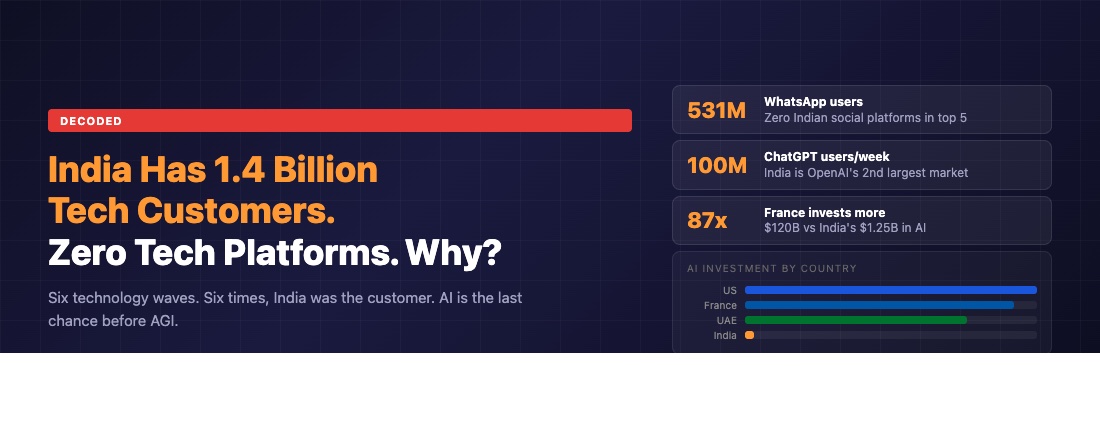
Smartphones: 931M users. Zero Indian brands in the top 7.
E-commerce: $211B market. 79% controlled by Walmart and Amazon.
Cloud: $37B market. 70%+ goes to AWS, Azure, Google.
AI: 100M weekly ChatGPT users. India is OpenAI's second-largest market.
Six technology waves. Six times, India was the customer.
India's $283 billion IT sector is the country's proudest technology achievement. But look closer: 48% of that revenue is services — Indian engineers writing code for American and European companies. India exports labor, not products. Microsoft India alone sends $2.3 billion per year back to the US in royalties.
In social media, India has 531 million WhatsApp users, 517 million on Instagram, and 493 million on Facebook. All three are owned by Meta, a company headquartered in Menlo Park, California. India's data — conversations, photos, purchase signals, political preferences — lives on American servers, governed by American laws.
In smartphones, Chinese brands control over 60% of the Indian market. Vivo, OPPO, Xiaomi, Realme — none are Indian. Even Flipkart, the e-commerce company Indians think of as homegrown, is owned by Walmart.
The minister himself has acknowledged the gap: "We, as a country, have been a great service nation. Now we must become a product nation also." India is still building its first indigenous web browser in 2025. Google Chrome has 65% of the global market.
The Hidden Tax on Indian InnovationEvery Indian AI startup faces a cost that no American competitor does: the dollar tax. Cloud services from AWS, Azure, and Google are billed in US dollars. The rupee has gone from Rs 45 per dollar in 2010 to Rs 91 in February 2026 — a 100% depreciation. A $1,000 monthly cloud bill that cost Rs 45,000 fifteen years ago now costs Rs 91,000, with zero change in usage.
On top of that, add 18% GST on all cloud and SaaS services, plus 1-3% bank forex conversion charges on every transaction. An Indian developer effectively pays 25-30% more than an American developer for the identical GPU hour, the identical API call, the identical cloud instance.
The government already has a precedent for solving this. RBI's Special Rupee Vostro Account framework lets 22 countries settle trade in rupees — India even buys Russian oil in rupees now. If a platform has 100 million Indian users, could it be required to offer rupee-denominated pricing? The infrastructure exists. The policy doesn't.
India Just Built 3 AI Models. From Scratch.At the India AI Impact Summit in February 2026, something happened that deserves more attention than it got. India launched three sovereign AI models — not fine-tuned adaptations of American models, but systems built from scratch on Indian compute, using Indian data.
Sarvam AI released a 105-billion-parameter model that outperforms DeepSeek R1 — a 600B-parameter Chinese model — on Indian language benchmarks. Its 30B model, codenamed Vikram, activates only 1 billion parameters per token using mixture-of-experts architecture, making inference dramatically cheaper. BharatGen launched Param2, a 17B model covering all 22 scheduled Indian languages, built by IIT Bombay with NVIDIA. Gnani.ai released a voice-to-voice model trained on 14 million hours of multilingual speech.
India's government also offers subsidized GPU access at Rs 65 per hour for startups and researchers — a fraction of commercial cloud rates. And UPI, India's payment system, has already proven that India can build world-class technology when it commits. The talent exists. India ranks 2nd globally in AI talent.
France Committed 87x More. UAE Committed 80x Per Capita.| Country | Population | AI Investment | What They Built |
|---|---|---|---|
| United States | 330M | $109B private (2024) | GPT, Claude, Gemini, Llama |
| China | 1.4B | $9.3B + $47.5B chip fund | DeepSeek V3 for $5.6M despite US chip ban |
| France | 68M | €109B committed | Mistral ($14B valuation), 500K GPU target |
| UAE | 10M | $100B committed | Falcon-H1 tops Arabic LLM leaderboard |
| Saudi Arabia | 36M | $100B (Transcendence) | HUMAIN — sovereign AI under PIF |
| UK | 67M | £18B infrastructure pipeline | Isambard-AI supercomputer, Sovereign AI Unit |
| Japan | 125M | $65B semiconductor + AI | ¥1T public-private AI company |
| India | 1.4B | $1.25B (IndiaAI Mission) | Sarvam 105B, BharatGen 17B, a summit |
China built DeepSeek V3 for $5.6 million on 2,000 GPUs — despite a US chip ban. India has 38,000 GPUs. That's enough hardware for 19 DeepSeeks. Japan openly admitted it fell behind and funded a $6.34 billion public-private AI company to catch up. India pledged $200 billion at a summit. It has delivered $1.25 billion.
Fine-Tuning Foreign Models Is Renting. Building Is Owning.There's a critical distinction most summit speeches gloss over. A base LLM — a foundation model — is the raw intelligence. Everything else is built on top of it. When an Indian company fine-tunes GPT or Llama for Hindi, it's still dependent on an American foundation. If OpenAI changes its terms, raises prices, or restricts access, every Indian product built on top collapses overnight.
Critics have already flagged the "Sovereignty as a Service" trap: US companies invest in Indian data centers, offer subsidized compute, and call it "sovereign AI." But the models running on those servers are still American. The data flowing through them is still processed by American code. It's the digital equivalent of the East India Company — which is exactly what India's former IT minister once warned about.
AGI in 4 Years. India Has 1% of Global Compute.Metaculus forecasters put a 25% chance of AGI by 2029 and 50% by 2033. Anthropic CEO Dario Amodei says AI surpassing humans arrives "in 2-3 years." Google DeepMind says AGI is plausible by 2030.
India controls roughly 1% of global AI compute. The US controls 74%. India has 38,000 GPUs; the US has 3.67 million — a 100x gap. India is 100% dependent on NVIDIA for its GPUs, and its own chip manufacturing capacity is 3-5 years away. NVIDIA Blackwell chips are sold out through mid-2026.
If AGI arrives and India doesn't have its own foundation, the gap isn't just about AI — it's about everything that comes after. The country that controls AGI infrastructure controls the economic future. Every other country becomes a customer. Again.
India Has Something No One Else DoesHere's what gets lost in the pessimism: India has 1.4 billion people who need AI in 22 languages, across thousands of dialects, for use cases that Silicon Valley will never prioritize. No American company is going to optimize for a farmer in Madhya Pradesh filing a crop insurance claim in Bundeli, or a first-generation college student in Odisha who needs exam prep in Odia.
Sarvam AI's CEO put it clearly: "Sovereignty matters much more in AI than building the biggest models." The question isn't "Can India beat OpenAI?" It's "Will India build for India?"
$200 Billion Pledged. $1.25 Billion Delivered. Is This a Plan?Bloomberg's headline from the summit week: "India Can't Spectacle Its Way to AI Power." CNBC asked: "Is there substance behind the headlines?" Gavekal senior analyst Udith Sikand observed: "India is making splashy attempts to kickstart its belated AI push but is doing so primarily by offering headline-grabbing sops without addressing the underlying difficulties."
Nikhil Pahwa, founder of MediaNama, went further: the "battle is already lost" because global model adoption in India far exceeds local model adoption. The summit itself became a metaphor — Wi-Fi crashed, UPI collapsed under congestion, and a Chinese-made robot was passed off as Indian innovation.
Signs of Progress
- 3 sovereign models launched — Sarvam, BharatGen, Gnani — built from scratch, not fine-tuned
- India ranks 2nd globally in AI talent (Tortoise AI Index)
- UPI proved India can build world-class tech when it commits
- Subsidized GPU access at Rs 65/hour for startups
- Reliance pledged Rs 10 lakh crore ($110B) over 7 years
Structural Concerns
- India has 1% of global AI compute vs US at 74%
- $1.25B delivered vs France's $120B committed — 87x gap
- 100% NVIDIA dependency, own GPU 3-5 years away
- No concrete AI regulatory framework yet
- $200B pledged at summit, but pledges are not policy
The Bottom Line
India is the world's 3rd largest economy behaving like the 30th in technology. Every wave — social media, smartphones, e-commerce, cloud, search — India was the customer. India bought the phones, used the apps, stored data on foreign servers, and paid in dollars that keep getting more expensive. AI is the last platform shift before AGI. If India misses this one too, the next wave won't ask for permission. The talent is there. The 1.4 billion users are there. The 22 languages that no American company will ever prioritize — they're there. What's missing isn't capability. It's commitment. Not $200 billion in summit pledges — but $1.25 billion in actual spending (see the broader pattern in India's Budget 2026 priorities), at a time when France commits 87x more and the UAE commits 80x more per person. Sarvam, BharatGen, and UPI prove India can build. The question is whether India will build fast enough, or simply become AI's biggest customer too.