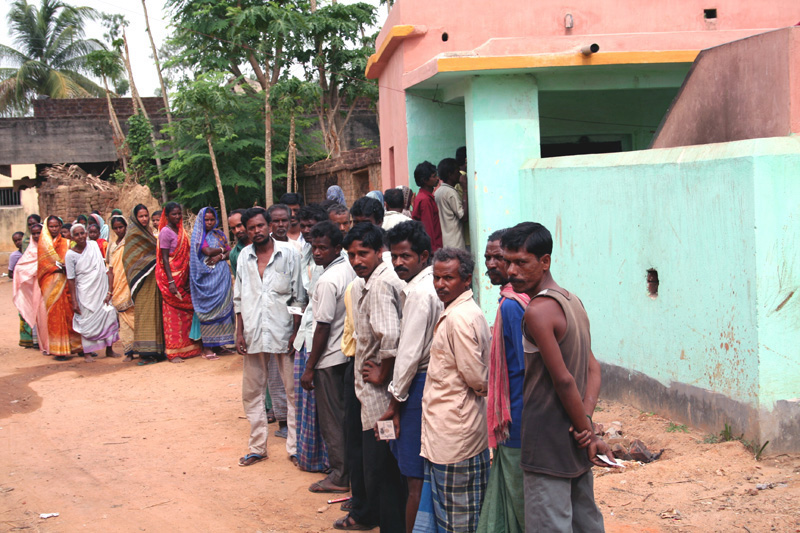
April 9, 2026. Assam, Kerala, and Puducherry vote.
April 23. Tamil Nadu and West Bengal (Phase 1).
April 29. West Bengal (Phase 2).
May 4. Results for all five states.
824 seats. 17.4 crore voters. 3 weeks.
The campaign rhetoric is about infiltration, demography, and religion. The voters' reality is about jobs, gas cylinders, and hospital beds. Somewhere between the two, India's democracy is having an identity crisis.
India is in the middle of an oil crisis. The Strait of Hormuz is effectively closed. Brent crude has crossed $126 per barrel. The rupee has crashed to a record 92.46 against the dollar. LPG cylinders are delayed by 25 days, and restaurants across the country are shutting because they can't get commercial gas.
Unemployment among 15-29 year olds remains above 12%. India's public healthcare system is so broken that 10 patients just died in an ICU fire in Cuttack because ventilators short-circuited and staff had to carry patients down the stairs.
And the number one campaign issue across Assam and Bengal? Infiltration.
Not inflation. Not the oil crisis. Not the fact that India has 9.5 days of strategic oil reserves while Japan has 260. The word that dominates rally after rally, speech after speech, headline after headline is: infiltrators.
"Double Engine" Means Double the Growth. Right? The Data Says No.The BJP's most powerful electoral pitch since 2017 has been the "double engine sarkar" — the claim that states with a BJP government at both the state and central level get faster development, more funds, and better infrastructure.
Here's what the numbers actually show:
| State | Ruling Party | Per Capita Income | GSDP Growth (2024-25) |
|---|---|---|---|
| Tamil Nadu | DMK (Opposition) | ₹3.62 lakh | 11.19% (India's highest) |
| Telangana | Congress (Opposition) | ₹3.37 lakh | 9.2% |
| Kerala | LDF (Opposition) | ₹3.73 lakh | 6.6% |
| Karnataka | Congress (Opposition) | ₹3.24 lakh | 8.1% |
| Gujarat | BJP (Double Engine) | ₹3.04 lakh | 7.4% |
| Madhya Pradesh | BJP (Double Engine) | ₹1.47 lakh | 6.8% |
| Uttar Pradesh | BJP (Double Engine) | ₹0.95 lakh | 5.9% |
| Bihar | NDA (BJP alliance) | ₹0.62 lakh | 5.1% |
A Print analysis found no correlation between "double engine" governments and economic growth. In fact, states with a different party at the state level performed slightly better.
The contrast is stark: Telangana's average citizen is 3.5 times richer than the average citizen of Uttar Pradesh, and grew richer at twice the rate between 2017 and 2023. UP has had a double engine sarkar the entire time.
India's most developed states by Human Development Index — Kerala, Goa, Delhi, Tamil Nadu, Himachal Pradesh — are mostly non-BJP or alternating governments. The bottom of the HDI table? UP, Bihar, Madhya Pradesh — BJP strongholds.
From Roads to Religion. When Did the Vocabulary Change?Rewind to 2014. Modi's pitch was aspirational: "Sabka Saath, Sabka Vikas." Development for all. The campaign talked about toilets, roads, electricity, Jan Dhan accounts, and good governance. Gujarat's growth was the evidence.
By 2019, the vocabulary had shifted. CAA and NRC dominated. The central question became: who belongs here? The Assam NRC was the trial run — an exercise to identify illegal immigrants. It found 1.9 million people excluded. The government had claimed 5 million.
By 2024, "infiltration" and "demographic change" were the primary campaign weapons. Modi lost his supermajority. Analysts noted that communal rhetoric had hit "diminishing returns" — voters were signalling that economic pain matters more than identity fear.
Now, in 2026, the same playbook is back. Louder than ever.
904 Caught in 5 Years. 20 Million Claimed. Where Are They?Let's start with what we know for certain. The Railway Protection Force — the government's own agency — has apprehended 586 Bangladeshis and 318 Rohingyas since 2021. Total: 904 people.
Now let's look at the claims:
| Source | Year | Claimed Number |
|---|---|---|
| Sriprakash Jaiswal (MoS Home) | 2004 | 12 million |
| Government estimate | 2009 | 15 million |
| Kiren Rijiju (MoS Home) | 2016 | 20 million |
| Assam NRC (actual exercise) | 2019 | 1.9 million excluded |
| Indian Statistical Institute | Various | "Motivatedly exaggerated" |
| RPF actual apprehensions | 2021-2026 | 904 |
The gap between claimed numbers and verified evidence is so vast that CJP's investigation concluded: "India is not home to crores of illegal immigrants, 'Bangladeshis' or otherwise."
None of this means illegal immigration doesn't exist. It does — across all borders, from all neighbouring countries. But the scale being claimed, and the political use being made of it, deserves scrutiny.
Can India Actually Send 20 Million People Back? The Law Says No.Even if 20 million illegal immigrants existed, could India deport them?
The legal reality is sobering:
1. India has no refugee law. It hasn't signed the 1951 Refugee Convention. There's no legal framework distinguishing refugees from illegal immigrants.
2. Non-refoulement is binding. India ratified the International Covenant on Civil and Political Rights (ICCPR), which means it cannot return people to places where they face threats to their lives. This is customary international law.
3. Bangladesh doesn't accept deportees. There is no bilateral deportation agreement. When India has attempted pushbacks, Bangladesh has formally protested, saying protocols weren't followed. Human Rights Watch documented hundreds of Muslims "unlawfully expelled" without due process.
4. The logistics are impossible. You'd need to identify, verify citizenship of, and transport millions of people — each with the right to legal appeal. The Assam NRC took 4 years and ₹1,600 crores to process just 3.3 crore people. Scaling that nationally would take decades.
So the promise of "catching and deporting infiltrators" is, in practical terms, a promise that cannot be kept. It can only be campaigned on.
72,312 Tibetans Welcome. 40,000 Rohingya in Detention. Why Only Bangladeshi Muslims?India has millions of people from neighbouring countries living within its borders. Here's how they're treated:
| Group | Numbers | Status | Religion |
|---|---|---|---|
| Tibetan refugees | 72,312 | Residency, work permits, education | Buddhist |
| Sri Lankan Tamil refugees | 58,843 | Govt-assisted camps, recognised | Hindu |
| Afghan refugees | ~15,000 | UNHCR cards, some visas | Mixed |
| Rohingya | ~40,000 | Slums, detention centres | Muslim |
| Bangladeshi (alleged) | Unknown | Targeted for deportation | Muslim |
Outlook India put it plainly: "All Refugees Are Not Equal In India."
The Citizenship Amendment Act itself codifies this hierarchy: it grants fast-track citizenship to persecuted Hindus, Sikhs, Buddhists, Christians, Jains, and Parsis from Afghanistan, Bangladesh, and Pakistan. It explicitly excludes Muslims — even persecuted ones like Ahmadiyyas from Pakistan or Hazaras from Afghanistan.
The pattern is clear. India's immigration debate isn't really about immigration. It's about which immigrants.
5 States, 5 Different Battles — But Only 2 Have Made Development the Issue West Bengal: The Demography BattlegroundPM Modi made infiltration his central campaign plank in Bengal. Amit Shah called it a "safe haven for infiltrators." The SIR (Special Intensive Revision) voter list exercise has become the key flashpoint — BJP says it catches illegal voters, TMC says it disenfranchises genuine citizens. The EC has already suspended 7 officials for misconduct.
Bengal's actual issues? Crime against women, teacher recruitment scams, corruption allegations, and post-poll violence fears.
Assam: The Polarisation LaboratoryChief Minister Himanta Biswa Sarma has turned polarisation into governance. He applied the word "jihad" to education, marriage, agriculture, and even natural disasters. He reposted an AI-generated video of himself firing at skull-capped men. Since 2021, his government has evicted 50,000 people — predominantly Muslim Bengali-origin communities.
Assam's actual issues? Infrastructure gaps, identity movements, unemployment, and the unfulfilled promises of NRC and CAA.
Tamil Nadu: Governance on TrialHere, the conversation is different. The DMK is running on its 11.19% GSDP growth record. The AIADMK is attacking on debt (₹4.85 lakh crore to ₹10+ lakh crore under DMK). BJP is marginal. The debate is about unfulfilled promises, corruption, crime against women, and the drug menace.
No one is talking about infiltration. The election is about governance.
Kerala: Welfare vs. Financial ManagementLDF (Left) is running on its welfare track record: pensions raised from ₹600 to ₹2,000, social security for homemakers, and what it calls the most successful poverty eradication programme in India. UDF (Congress) is attacking on corruption and financial mismanagement. Shashi Tharoor is leading the Congress charge.
Again: the contest is about governance. Not identity.
The South's Approach
- Tamil Nadu, Kerala: Election debate centred on economic performance, welfare delivery, corruption
- Candidates challenged on specific promises (NEET scrapping, OPS, jobs)
- Result: South Indian states have India's highest HDI, per capita income, and GSDP growth
The North/East Approach
- Bengal, Assam: Infiltration, demographic change, SIR voter lists dominate
- Development metrics rarely challenged in campaigns or debates
- Result: Eastern states lag on most socioeconomic indicators
There's a tectonic shift coming that may make all of this irrelevant.
For the first time since 1931, India will formally record jatis and sub-castes in the 2026-27 census. The Bihar caste survey already revealed the political earthquake waiting: EBCs make up 36% of the population. OBCs and EBCs combined = 63% of the electorate.
This has implications for constituency delimitation, reservations, women's quota implementation, and every seat calculation in every state.
The BJP, which opposed caste census for years, suddenly embraced it after losing OBC vote share in Karnataka, Telangana, and the 2024 national election. Outlook noted: it reveals "a party recalibrating in real time."
If caste enumeration data becomes public before the next general election, identity politics could shift from religion to caste — and the entire "infiltration" narrative may lose its electoral value overnight.
What Can You Actually Do? A Voter's ChecklistElections don't have to be about fear. Here's how to bring core issues back to the ballot:
Before You Vote: 5 Questions for Your Candidate
- Jobs: What is your specific plan for employment in this constituency? How many jobs were created in the last 5 years?
- Healthcare: How many primary health centres are functional? What's the doctor-to-patient ratio? When was the last hospital fire audit?
- Education: What's the teacher vacancy rate in government schools? How many classrooms don't have basic infrastructure?
- Infrastructure: Show me the utilisation of MPLADS/MLALADS funds. What percentage was actually spent vs. lapsed?
- Accountability: How many days were you present in the assembly? How many questions did you raise? What legislation did you introduce?
Tools to Check Before You Vote
- PRS Legislative Research (prsindia.org): State assembly attendance records, questions raised, bills passed
- MyNeta / ADR (myneta.info): Criminal records, assets, education of every candidate
- MPLADS tracker: How much development fund your MLA/MP actually spent
- State economic surveys: Available on respective state government websites — verify GDP, employment, health claims
- NOTA: If no candidate talks about your issues, NOTA is a valid democratic signal. High NOTA percentages force parties to rethink candidate selection.
The point isn't to support any party. It's to make every party answer for what they did — not what they said about the other side.
The Bottom Line
India's elections are no longer a test of governance. They're a test of identity. The states that still argue about development — Tamil Nadu, Kerala — are India's richest and most developed. The states where infiltration dominates the discourse — UP, Bihar, Assam — remain at the bottom of every development index. The correlation isn't coincidence. When elections become about who belongs, no one asks who delivered. The only people who can change this equation are the ones who vote. The data exists. The tools exist. The question is whether the voter will ask for roads — or accept being offered walls.