March 21, 2024: The Enforcement Directorate arrests Arvind Kejriwal — a sitting Chief Minister pulled from his residence. He will spend ~156 days in custody before the Supreme Court grants bail.
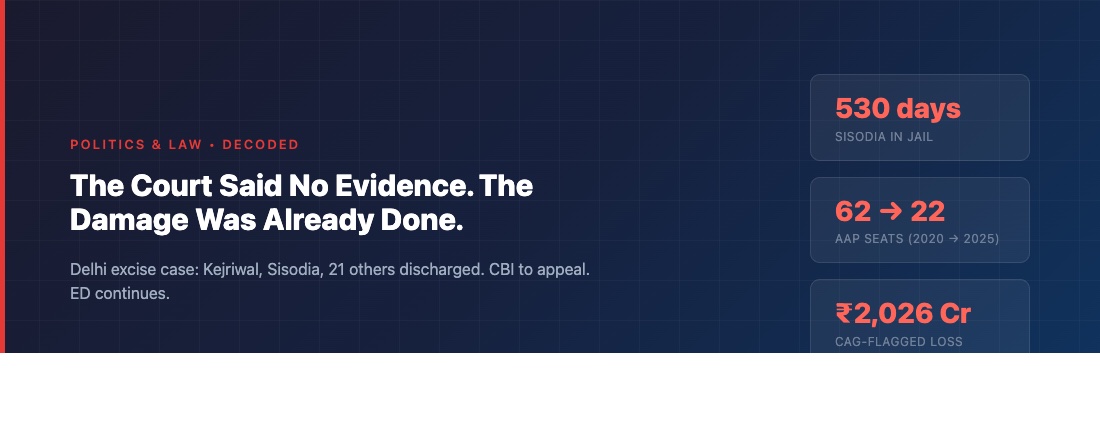
February 27, 2026: Special Judge Jitendra Singh delivers his order. "No overarching conspiracy. No criminal intent." All 23 accused — including Kejriwal, Sisodia, K Kavitha, Sanjay Singh, and Vijay Nair — are discharged.
Same day: The CBI announces it will challenge the verdict in Delhi High Court.
Four years. Two central agencies. One chargesheet the court called "conjectural."
On February 27, 2026, Special Judge Jitendra Singh of the Rouse Avenue Court in New Delhi delivered his order on the CBI's chargesheet in the Delhi excise policy case. The order did not mince words. Here are the key findings:
The court found "no overarching conspiracy or criminal intent" in the formulation or implementation of the 2021-22 Delhi excise policy. It held that the CBI's chargesheet was built on "conjectural" reasoning — conjecture, not evidence. The judge noted that Arvind Kejriwal had been "implicated without any cogent material" linking him to any criminal act. For Manish Sisodia, the court found that the CBI failed to make out a prima facie case.
Perhaps most significantly, the court described the CBI's investigation as "pre-meditated and choreographed" — a phrase that carries weight from a sitting judge evaluating a federal investigation agency's work. The court also ordered a departmental inquiry against the CBI's Investigating Officer who handled the case.
All 23 accused persons — politicians, bureaucrats, businesspeople, and party functionaries — were discharged.
Discharge vs. Acquittal — Why the Distinction Matters
Discharge means the court has examined the prosecution's evidence and concluded there is not enough material to even begin a trial. Charges are never framed. The case does not proceed to the trial stage.
Acquittal is what happens after a full trial — when the court hears all evidence, examines witnesses, and finds the accused not guilty.
In this case, the prosecution's evidence was so weak that the court determined there was no point starting a trial at all. However, discharge is not the end. The CBI can — and has announced it will — file a criminal revision petition in the Delhi High Court. The High Court can uphold the discharge, overturn it and order a trial, or direct a fresh investigation.
The court's finding that there was no criminal conspiracy does not mean the excise policy was without problems. A separate audit by the Comptroller and Auditor General of India — the CAG, India's constitutional auditor — found significant financial irregularities in the same policy.
The CAG report, tabled in the Delhi Assembly in 2025, flagged a total revenue loss of ₹2,026 crore to the exchequer:
| Irregularity | Amount | Detail |
|---|---|---|
| No tenders for 19 zones where licenses were surrendered | ₹890 Cr | Revenue foregone when zones went untendered |
| Court issues not resolved before tender process | ₹941 Cr | Pending litigation impacted revenue collection |
| License fees waived under COVID relief pretext | ₹144 Cr | Waivers granted without adequate justification |
| Errors in security deposit calculations | ₹27 Cr | Computational mistakes in deposits collected |
| Total flagged revenue loss | ₹2,026 Cr | CAG Report, 2025 |
To understand the scale of this case, trace the four years from policy launch to discharge:
Four years of investigation, incarceration, and political upheaval left a trail of measurable consequences. Here is the accounting — human, electoral, and financial.
The Human Cost| Person | Role | Days in Jail | Political Cost |
|---|---|---|---|
| Manish Sisodia | Deputy CM, Education Minister | ~530 days | Lost Jangpura seat (2025) |
| Arvind Kejriwal | Chief Minister | ~156 days | Lost New Delhi seat by 4,089 votes |
| K Kavitha | BRS MLC (Telangana) | Multiple months | Case in different state entirely |
| Sanjay Singh | AAP Rajya Sabha MP | Months | Released on bail |
| Vijay Nair | AAP communications | ~2 years | First to be arrested (Sep 2022) |
| 18 others | Various | Varying | Lives disrupted for 4 years |
| Metric | Before Case (2020) | After Case (2025) | Change |
|---|---|---|---|
| AAP seats in Delhi | 62/70 | 22/70 | -40 seats |
| BJP seats in Delhi | 8/70 | 48/70 | +40 seats |
| Kejriwal's constituency | Won | Lost by 4,089 | — |
| Sisodia's constituency | Won | Lost | — |
| AAP jailed leaders' seats | Won | All lost | 0/5 |
Whether the excise case caused AAP's electoral decline or merely accompanied it is a matter of interpretation. The BJP argues that voters rejected AAP's governance record. AAP argues the case was designed to cripple the party before elections. The data shows the correlation; causation remains contested.
The Revenue Question| Metric | Value | Source |
|---|---|---|
| Revenue under new policy (2021-22) | ~₹8,900 Cr (27% increase) | Delhi Excise Dept |
| CAG-flagged revenue loss | ₹2,026 Cr | CAG Report 2025 |
| Projected target FY23 | ₹9,454 Cr | Budget Estimates |
| Policy withdrawn | September 2022 | — |
| Court's finding | "No criminal conspiracy" | Feb 2026 judgment |
| CBI conviction rate overall | 74.59% (2022) | PIB |
While the case dominated headlines and courtrooms, Delhi — a city-state of over 20 million people — experienced a period of diminished governance capacity. This is not about assigning blame to any party. It is about documenting what happened while key decision-makers were unavailable.
Manish Sisodia held the education portfolio — Delhi allocated roughly 25% of its state budget to education, the highest proportion of any Indian state. Under his tenure, the government built three new universities: Delhi Skill and Entrepreneurship University (DSEU), Delhi State University (DSU), and Delhi Teachers University. Delhi government schools surpassed private school results in board examinations for seven consecutive years.
The timing carries a particular irony: the New York Times published a major feature recognizing Delhi's education reforms in August 2022 — the same month the CBI registered its FIR against Sisodia.
With Sisodia in jail from February 2023 and Kejriwal arrested in March 2024, Delhi's administration operated without its two most senior elected officials for extended periods — during a period when the Union Budget 2026 was being shaped and state-level priorities needed advocacy. During this time: a heatwave in the summer of 2024 killed over 300 people, a recurring water crisis went unaddressed, and the ongoing deadlock between the elected government and the Lieutenant Governor over administrative control deepened.
None of this proves causation. Heatwaves happen regardless of who is in charge. Water crises have structural causes spanning decades. But the absence of elected leadership during a period of compounding urban challenges is a fact worth noting.
Two Agencies, One Case — How CBI and ED WorkFor anyone following this case — especially younger readers encountering these acronyms for the first time — here is what the two agencies are and why both investigated the same set of events.
The CBI (Central Bureau of Investigation) investigates corruption by public servants under the Prevention of Corruption Act, 1988. It examines whether government officials misused their position for illegal gain. In this case, the CBI alleged that Delhi government officials conspired with liquor licensees to manipulate the excise policy for kickbacks.
The ED (Enforcement Directorate) investigates money laundering under the Prevention of Money Laundering Act (PMLA), 2002. It traces the movement of money that is allegedly the proceeds of a crime. Critically, the ED's case is built on a "predicate offense" — in other words, there must be an underlying crime (like the CBI case) for money laundering charges to hold.
Here is where the two cases now stand:
CBI Case — Discharged
- All 23 accused discharged by trial court
- Court found no evidence of criminal conspiracy
- Chargesheet called "conjectural"
- IO inquiry ordered for investigation conduct
- CBI will appeal to Delhi High Court
ED Case — Still Ongoing
- Money laundering prosecution continues independently
- ED case was registered separately under PMLA
- Predicate offense (CBI case) now weakened
- Legal experts say PMLA case becomes harder — but not impossible — without predicate offense
- Trial in ED case has not concluded
AAP & Opposition Say
- Court found zero evidence of any conspiracy — complete vindication
- Kejriwal: "I am kattar imaandaar" (completely honest) — broke down after verdict
- Leaders lost years of freedom for a case with no evidence — Sisodia spent 530 days in jail
- Investigation officer's conduct so questionable that court ordered departmental inquiry
- Punjab CM: "Truth always triumphs" — verdict proves agencies were politically weaponized
BJP & Government Say
- "Discharge is not acquittal" — Sudhanshu Trivedi, BJP spokesperson
- "If policy was clean, why was it rolled back?" — BJP leaders
- "How were charges framed if they were baseless?" — questioning the original charge-framing process
- CBI will file criminal revision petition in Delhi High Court — legal process far from over
- ED's independent money laundering investigation continues separately
The discharge order of February 27, 2026, is not the final word. Here is what lies ahead:
CBI's appeal: The CBI has announced it will file a criminal revision petition in the Delhi High Court challenging the discharge. The High Court has three options: (a) uphold the trial court's discharge order, effectively ending the CBI case; (b) overturn the discharge and send the case back for trial, meaning charges would be framed and a full trial would commence; or (c) order a fresh investigation with directions for the CBI to re-examine the evidence.
ED's continuing case: The money laundering prosecution under PMLA continues independently. This case has its own proceedings, its own evidence, and its own timeline. However, the collapse of the predicate offense (the CBI case) raises a fundamental question about the legal foundation of the money laundering charges. Defense lawyers are expected to challenge the ED case on these grounds.
Political implications: For AAP, the discharge provides a legal vindication that the party will use in its narrative ahead of municipal and future state elections. For the BJP, the CBI appeal and the continuing ED case provide space to argue that the legal process is not over. For the broader political discourse, the case will continue to be cited in debates about the independence of investigative agencies and the use of law enforcement as a political tool.
The Pattern — High-Profile CBI CasesThe Delhi excise case is not the first high-profile CBI investigation to end in discharge or acquittal. Here is a record of past cases where federal charges against prominent political figures did not survive judicial scrutiny:
| Case | Accused | Outcome |
|---|---|---|
| Delhi Excise Policy (2026) | Kejriwal, Sisodia + 21 others | All 23 discharged — "conjectural" case |
| Sohrabuddin Encounter (2014) | Amit Shah | Discharged — lack of evidence |
| Aarushi Talwar Murder (2017) | Rajesh & Nupur Talwar | Acquitted by Allahabad HC |
| Jain Hawala Case (1990s) | 20 defendants incl. top leaders | All discharged |
| 2G Spectrum Scam (2017) | A. Raja, Kanimozhi + others | All acquitted by trial court |
The Bottom Line
On February 27, 2026, a Delhi court concluded that the CBI's excise policy case — which led to the arrest of a sitting Chief Minister, kept his deputy in jail for 530 days, and dominated three election cycles — was built on what the judge called "conjectural" evidence. The CBI disagrees and will appeal. The ED's money laundering investigation continues. The CAG's findings of ₹2,026 crore in revenue irregularities remain on record. What the court's 23-person discharge does establish is this: the legal bar for depriving citizens of liberty is higher than the political bar for shaping public opinion — and the gap between the two is where this story lives.