March 4: Bihar Minister Vijay Kumar Chaudhary confirms: "Nitish is considering a shift to Rajya Sabha."
March 5: Nitish Kumar confirms on X: "I wish to become a member of the Rajya Sabha in the elections being held this time." Nomination papers filed. He assured: "full cooperation and guidance to the new government."
March 6: Nomination scrutiny.
March 9: Last date to withdraw nominations.
March 16: Rajya Sabha voting + counting at 5 PM. Bihar's longest political era officially ends.
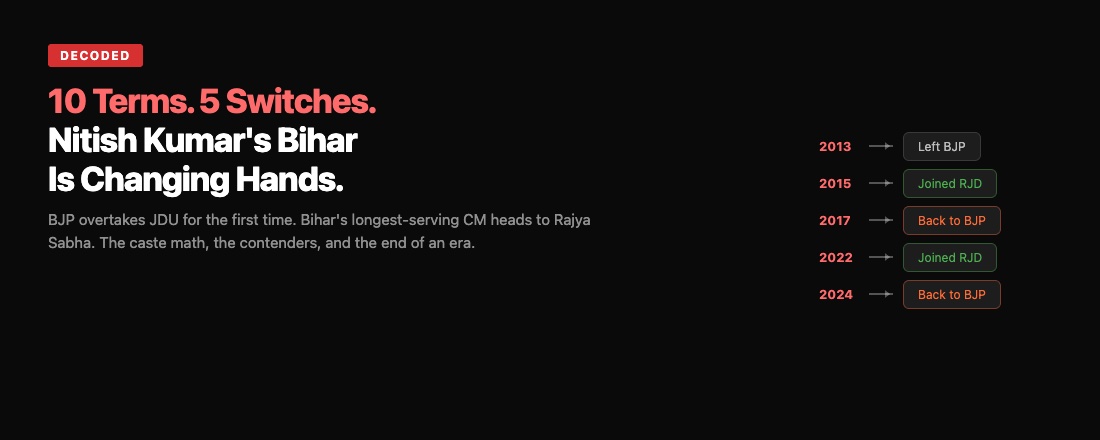
It's confirmed. Nitish Kumar has been Chief Minister of Bihar for longer than most Biharis can remember. Ten terms. Twenty-one years across those terms. Five alliance switches. He's 75 years old, and on March 5 he confirmed he is moving to the Rajya Sabha.
The question is no longer whether Bihar gets a new CM. The nomination is filed. The question is who replaces him, and what that choice tells us about where Indian politics is headed.
What Bihar Gave Nitish. What Nitish Gave Bihar.Start with what Nitish Kumar actually achieved. In 2005, Bihar was India's punchline — the "BIMARU" state, synonymous with lawlessness, kidnapping, and stagnation. Nitish inherited a state where female illiteracy was over 60% and teachers didn't show up to schools.
What followed is sometimes called the "Bihar miracle." He appointed over 100,000 school teachers. His bicycle scheme for girls dramatically increased female school enrollment. He cut female illiteracy by half. Bihar's GSDP grew at a CAGR of 11.42% between 2015 and 2026, reaching Rs 10.97 lakh crore ($128.89 billion). In 2022-23, Bihar's economy grew at 17.9% — faster than India's GDP growth.
But the numbers hide a duality. Bihar remains one of India's poorest states by per-capita income. His liquor prohibition, imposed in 2016, has killed over 150 people from spurious alcohol. And then there's the nickname that defines his later career: "Paltu Ram" — the man who keeps switching sides.
89 > 85. The Number That Ended an Era.Here's the number that matters more than Nitish's age or health: in the November 2025 Bihar elections, the BJP won 89 seats. JDU won 85.
Read that again. For the first time since the alliance began, BJP is the larger party. In 2020, JDU had 43 to BJP's 74 — BJP was already ahead, but Nitish still held the CM post through sheer political maneuvering. In 2025, with the NDA winning a crushing 202 of 243 seats, the power dynamic became impossible to deny.
The BJP no longer needs Nitish Kumar. And it's making that clear.
| Election | JDU Seats | BJP Seats | Who Was Bigger? |
|---|---|---|---|
| 2010 | 115 | 91 | JDU |
| 2015 | 71 | 53 | JDU (with RJD) |
| 2020 | 43 | 74 | BJP |
| 2025 | 85 | 89 | BJP |
Nitish Kumar's political career is defined by one pattern: the switch. He has crossed the aisle more times than any major Indian leader in modern history. Understanding the sequence explains why the BJP finally decided enough is enough.
Each switch eroded trust. Each return came with fewer seats. The trajectory was clear: by 2025, Nitish was no longer the kingmaker. He was the king who stayed on borrowed time.
63% Backward. 15% Forward. The Caste Math That Decides Everything.No analysis of Bihar politics is complete without caste. The Bihar Caste Census of 2022 gave India its first-ever granular picture of the state's demographics. The numbers explain every political decision.
| Category | Population % | Political Significance |
|---|---|---|
| EBC (Extremely Backward Classes) | 36.01% | 112 sub-castes. Influence ~120 assembly seats. Historically Lalu's base, shifted to NDA under Nitish. |
| OBC (Other Backward Classes) | 27.12% | Includes Yadavs (~14%), Koeris, Kurmis. RJD's core base. |
| Scheduled Castes | 19.65% | Key for LJP (Chirag Paswan's Paswan community), Congress, Left. |
| Scheduled Tribes | 1.68% | Minimal political weight. |
| General / Forward Castes | 15.52% | Rajputs, Bhumihars, Brahmins, Kayasthas. BJP's traditional base. |
The key equation: EBC + OBC = 63% of Bihar's voters. Whoever consolidates this bloc wins. Nitish Kumar, a Kurmi (OBC), held this coalition together for two decades. The question now is whether the BJP can hold it without him.
The 2025 results suggest they can. Upper castes staged a dramatic comeback: Rajputs won 32 seats (up from 18), Bhumihars 23 (up from 17), Brahmins 14 (up from 12). The old M-Y (Muslim-Yadav) equation that powered the RJD has collapsed. What replaced it is what analysts call "Bhura Baal" — upper castes + middle OBCs, a combination that gives NDA a near-unbeatable majority.
How the Exit Works. Rajya Sabha, Not Retirement.Nitish isn't retiring. He's moving to the Rajya Sabha — and the distinction matters.
Bihar has 5 Rajya Sabha seats up for election on March 16. The NDA, with 202 MLAs, can win all five (each seat requires ~41 MLA votes). BJP has announced two candidates: Nitin Nabin (BJP National President) and Shivesh Kumar Ram. Nitish confirmed on March 5 that he is filing his nomination.
The deal is done. He moves to Delhi, likely gets a cabinet berth in the Modi government, and Bihar gets a new CM. He assured supporters that his "relationship with Bihar will continue" and promised "full cooperation and guidance to the new government."
His son Nishant Kumar — a software engineer from BIT Mesra who has never contested an election — may get the other JDU Rajya Sabha seat, or even a Deputy CM post. Dynasty, it seems, is a bipartisan tradition.
Samrat Choudhary, Vijay Sinha, Nityanand Rai, or Giriraj Singh?The BJP has four realistic options for the next Bihar CM. Each signals a different political strategy.
| Contender | Caste | Current Role | Odds |
|---|---|---|---|
| Samrat Choudhary | Koeri (OBC) | Deputy CM + Home Minister | Frontrunner |
| Vijay Kumar Sinha | Rajput (Upper Caste) | Deputy CM | Possible |
| Nityanand Rai | Yadav | Union MoS Home Affairs | Outside chance |
| Giriraj Singh | Bhumihar (Upper Caste) | Union Minister | Unlikely |
Why Samrat Choudhary leads: He's already Deputy CM, Home Minister, and leader of BJP's legislative party in Bihar. His Koeri (OBC) identity is critical — in a state where 63% of voters are backward classes, the BJP needs a backward-caste CM to hold the coalition Nitish built. An upper-caste CM (Sinha or Giriraj) risks driving EBC and OBC voters away from the NDA.
The Nityanand Rai wildcard: He's a Yadav — the same community that forms RJD's core. Making him CM would be a devastating blow to Tejashwi Yadav's voter base. But it would also alienate BJP's traditional upper-caste supporters. High risk, high reward.
Why BJP Should Pick an OBC CM
- 63% of Bihar is EBC+OBC — they need representation at the top
- Samrat Choudhary already leads the legislative party — smooth transition
- Signals BJP is an inclusive party, not just an upper-caste party
- Holds the non-Yadav backward vote that Nitish consolidated
Why BJP Might Pick an Upper Caste CM
- Rajputs and Bhumihars delivered massive seat gains in 2025 — they want reward
- Giriraj Singh is a national-profile Hindutva leader — energizes the base
- BJP already has OBC representation through Chirag Paswan (LJP) at the centre
- Upper-caste CMs have historically held Bihar longer (pre-Nitish era)
If Nitish files his nomination today (March 5), the countdown begins:
March 16: Rajya Sabha voting. Nitish becomes an MP. He resigns as CM.
March 16-20: BJP's central leadership (Modi, Shah, Nadda) picks the new CM. The NDA legislative party "elects" the chosen candidate. The new CM takes oath.
April onward: The new CM faces immediate tests. The liquor ban decision is the first. BJP leaders including Giriraj Singh have called it a failure. Over 150 hooch deaths. Will the new CM lift it? Politically toxic either way — lifting it angers women voters who credit Nitish, keeping it angers BJP's own base.
The JDU question: What happens to JDU's 85 MLAs? Without Nitish, JDU has no comparable leader. The party has never won an election without him. Some MLAs may migrate to BJP over time — a familiar pattern in Indian politics. Nitin Nabin's appointment as BJP National President from Bihar signals the party believes its dependency on JDU is ending.
Plot Twist: The Software Engineer Who May Become Deputy CMThe most surreal subplot in this story is Nishant Kumar — Nitish's son.
Here's what we know: He's approximately 50 years old. He studied at BIT Mesra. He's a software engineer. He has never contested an election. He has been conspicuously absent from Bihar politics for his father's entire career. And now, reports say he may either get a Rajya Sabha seat, a Modi cabinet berth, or even a Deputy CM post in Bihar.
This is the man who built his political identity on being anti-dynasty — who attacked Lalu Prasad for promoting Tejashwi, who mocked Congress for its Gandhi family loyalty — now potentially creating a Kumar political dynasty. The irony is thick enough to cut.
If Nishant does enter politics, it serves a strategic purpose: it keeps JDU in the Kumar family, preventing the party from fragmenting post-Nitish. For BJP, it's a useful arrangement — a weakened, family-run JDU is easier to manage than a JDU with an independent, ambitious leader.
The End of Nitish Is the End of the "Third Way" in BiharZoom out from the daily politics, and what's actually ending is a model. For two decades, Nitish Kumar represented the idea that a leader could survive between the BJP and the RJD — taking the best of both, governing as a centrist with backward-caste support. He was proof that you didn't need to be Modi or Lalu. You could be something else entirely.
That era is over. The 2025 results tell the story: NDA 202, Mahagathbandhan 34. The opposition is effectively dead in Bihar. The RJD collapsed from 75 seats (2020) to 25 seats (2025). Congress won 6. Prashant Kishor's Jan Suraaj won zero seats, finishing behind NOTA in 68 constituencies.
Tejashwi Yadav faces a structural problem: the Yadav community is ~14% of Bihar's population. Even with full Yadav consolidation plus Muslim support, it's not enough to win without significant OBC, EBC, or upper-caste crossover. The M-Y equation that powered Lalu Prasad's politics is dead.
What replaces the Nitish model is a Bihar fully integrated into BJP's national framework. One party, one ideology, one organizational machine. Whether that's good or bad for Bihar's 130 million people depends entirely on who you ask.
The Bottom Line
Nitish Kumar's likely departure marks the end of India's most significant state-level political career since Lalu Prasad's. He transformed Bihar from a failing state into one of India's fastest-growing economies, but his legacy is permanently stained by 5 alliance switches, 150+ liquor ban deaths, and the inability to groom a successor. The BJP is poised to claim its first Bihar CM since 2005, with Samrat Choudhary (Koeri/OBC) as the frontrunner — a choice that would signal the party's commitment to backward-caste representation. The real question isn't who becomes CM next. It's whether JDU survives without the only leader it has ever known, and whether Bihar's transformation can continue without the man who started it.